

Dream On

Dream On
Drum Sheet Music

Practice Aerosmith on Drums

Intermediate

See How Drummer Tube Helps You Learn Songs Faster

Want access to all lessons?

View Plans >> Unlock this song – $7.90

Learn to Play Dream On Faster With Pro Interactive Drum Player

Play Sample Song For Free

Master This Song

$7.90

Original + Simplified

  • Download both versions as drum sheet PDFs
  • Play along with both versions in the interactive player for 2 months
Buy This Song

One-time payment · No subscription

Original
Simplified

Choose your Drum Sheet Version

Two versions of the drum sheet - choose the one that fits your level and goals.

ORIGINAL VERSION
Difficulty Level:
Intermediate
  • Exactly as played on the original recording
  • All fills & ghost notes
  • Full arrangement
SIMPLIFIED VERSION
Difficulty Level:
Easy
  • Easier to learn
  • Simplified fills
  • Reduced ghost notes
  • Perfect for beginners & intermediates

Not sure which version?

We recommend starting with the Simplified Version and moving to the Original Version once you're comfortable with the groove and structure.

Unlock all songs library and practice like a pro:

$10 / month

Billed at $120 per year

  • 7-day free trial
  • Full access to all songs
  • Interactive player
  • Downloadable drum sheets
  • Full support
  • Cancel anytime
  • 30-day money-back guarantee

$15 / month

Billed at $15 per month

  • Full access to all songs
  • Interactive player
  • Downloadable drum sheets
  • Full support
  • Cancel anytime

Drumming Techniques You'll Learn in Dream On

  • Slow Tempo Pocket Control
  • Dynamic Volume Scaling Precision
  • Late Entry Timing Accuracy
  • Eighth Note Hi Hat Endurance
  • Linear Tom Fill Fluidity

Recommended For

This printable drum sheet is recommended for intermediate drummers looking to master slow-tempo ballad pocket control and extreme dynamic scaling. It is exceptionally valuable for rock players wanting to develop precise late-entry timing, while learning to support a dramatic classic arrangement with absolute metronomic stability, confidence, and musical restraint.

Learn to play Dream On on drums

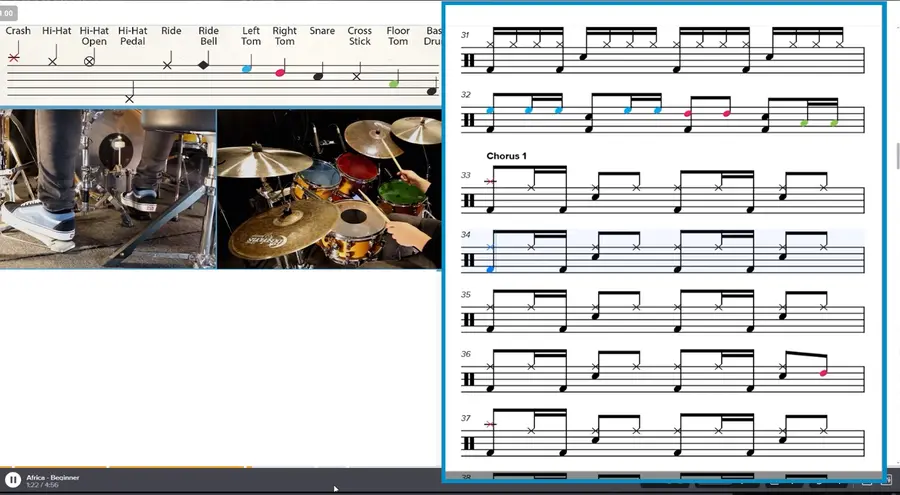
Play Dream On drum cover with our interactive drum sheet and synchronized video player. Follow every note in real time as the synchronized drum notation moves with the music, slow down challenging power-ballad transitions with tempo control, loop difficult fill sequences until they feel completely natural, and use isolated drums to hear every nuance of Joey Kramer's studio performance. Whether you are building confidence with slow-tempo control or refining your dramatic power-ballad orchestral builds, our step-by-step learning tools make using this interactive drum sheet faster and far more effective than practicing from a static PDF alone. Grab your drumsticks, open your digital drum transcription, and master this building classic today!

Song information

Artist: Aerosmith

Drummer: Joey Kramer

Album: Aerosmith

Released: 1973

Sheet Music Details

Length

2 pages of highly readable, clean drum score layouts.

Tempo

70-79

Time Signature

4/4

Key features

Features a famous late drum entry, slow-tempo power-ballad phrasing, extreme dynamic volume scaling, continuous eighth-note hi-hat work, wide-open crash-cymbal riding, and dramatic single-stroke tom sweeps requiring exceptional micro-timing precision and structural restraint.

Song's Overview

Released in 1973 on Aerosmith’s self-titled debut album, Dream On laid the foundational blueprint for the rock power ballad, altering how rock musicians balanced classical orchestral structures with heavy blues rhythms. Built around a somber, melancholic piano line and atmospheric guitar arpeggios, the track establishes an eerie, spacious landscape that challenges a player's micro-timing precision before escalating into an aggressive, hard-hitting finale. For musicians who want to learn dream on drums, Joey Kramer's performance serves as an exceptional lesson in dynamic patience and late-entry arrangement support. The drumming avoids standard pop loops, opting instead to withhold its entry until more than two minutes into the piece. When the drums finally arrive, the dream on drum cover demands an unyielding eighth-note pulse on the closed hi-hat and deep, heavy snare backbeats that lock seamlessly with the bass guitar. Instead of frantic syncopation, the rhythm focuses on slow-tempo consistency and wide-open crash cymbal riding during the soaring choruses. Studying an accurate dream on drum sheet helps intermediate players analyze how subtle tom-tom sweeps and explosive hand-to-foot unisons shape a classic rock crescendo, making this detailed drumming transcription a definitive text for mastering stadium-scale drama.

See How Drummer Tube Helps You Learn Songs Faster

Want access to all lessons?

View Plans >> Unlock this song – $7.90

About the Drummer

Joey Kramer is the longtime drummer for the legendary American rock band Aerosmith. Joining the group at its inception in 1970, Kramer played an instrumental role in shaping the hard-rock sound of the 1970s and beyond, even originating the band's name. Renowned for his deep pocket, steady timekeeping, and R&B-influenced rock grooves, Kramer provides the solid backbone that drives Aerosmith's high-energy catalog. His ability to blend hard-hitting rock power with subtle syncopation has made his drum parts instantly recognizable and foundational to rock drumming.

Drumming Style

Joey Kramer’s drumming style bridges the gap between heavy American hard rock and classic R&B groove. Rather than focusing on rapid technical displays, Kramer prioritizes feel, solid timing, and a deep pocket. His snare drum hits are authoritative and consistent, often paired with steady, grooving bass drum patterns that lock seamlessly with bass guitarist Tom Hamilton. A defining element of his style is creative hi-hat phrasing—incorporating open-and-closed accents and syncopated barks that give heavy rock tracks a funky bounce. In ballads and anthems, Kramer demonstrates dynamic control, building tension gradually from quiet verse textures to explosive chorus climaxes without rushing the tempo.

Practice Advice

01
Start Below Full Speed
The song’s slow power-ballad tempo demands precise limb placement. Begin practicing the core pocket at 60 BPM before advancing to the original 80 BPM pulse. Focus on clean hand-to-foot alignment to establish a completely stable rhythmic base.
02
Loop the Late Entry
The moment the drums enter midway through the track requires perfect timing. Use loop mode to repeat this critical entry, ensuring your initial snare backbeat and bass drum downbeat drop cleanly without rushing or dragging the piano melody.
03
Avoid Rushing the Climax
A frequent mistake when learning this arrangement is pushing the tempo forward during the high-intensity vocal screams. Keep your internal clock steady and resist rushing, letting each snare stroke land squarely to maintain a heavy rock pocket.
04
Lock the Hi-Hat Pulse
Develop exceptional timing consistency by keeping your eighth-note hi-hat patterns uniform during the verses. Focus on controlled wrist movements and a low stick height, allowing the groove to breathe naturally without causing early forearm fatigue.
05
Master Orchestral Dynamic Building
The primary challenge is navigating the extreme volume shifts. Practice transitioning smoothly from the quiet, restrained hi-hat pattern into the explosive, open-crash riding of the final chorus, ensuring your dynamic scaling feels earned and powerful.

Learning Roadmap

Phase 1: Isolate the Silent Entry Metrics

Practice counting through the long, piano-driven opening sections with a metronome. Focus on identifying the precise measure where the drums enter the arrangement, ensuring your internal clock tracks the slow-tempo pulse perfectly before you ever strike a drum.

Phase 2: Solidify the Closed Hi-Hat Pocket

Master the primary groove of the second verse, focusing entirely on loose but controlled eighth notes on the hi-hat. Ensure your kick drum and snare backbeats align squarely with the bass guitar line without inducing physical tension.

Phase 3: Coordinate Explosive Chorus Transitions

Analyze the dramatic shift into the high-energy chorus where the ride and open crash cymbals take over. Practice executing the heavy tom-tom sweeps and clean hand-to-foot unisons, maintaining identical tempo despite the massive increase in volume.

Phase 4: Deliver the Full Orchestral Arrangement

Combine all phases to perform the full drum transcription from the quiet mid-song entry to the final, hard-hitting vocal climax. Focus on managing your physical endurance and dynamic contrast, keeping the rock-ballad momentum stable until the final fade-out.

FAQ

What is the skill level required to play Dream On on drums?

Dream On is best suited for intermediate drummers. While the pattern tempo is slow, maintaining steady timing and dramatic dynamic control requires good drum kit control.

What is the primary drumming challenge in Dream On?

The biggest challenge is controlling tempo and dynamics. Playing accurately at 79 BPM without rushing during high-energy crescendos demands strong internal timing.

What time signature is Dream On played in?

Dream On is written in standard 4/4 time signature throughout the entire song.

Does Dream On feature fast drum fills?

No, the drum fills are relatively simple and spacious, focusing on powerful crescendo accents rather than rapid technical speed.

What tempo is Dream On recorded at?

The original Aerosmith studio track is recorded at a steady tempo of 79 BPM.

Related songs

Pro Practice Feature

Still figuring this song out on your own?

Learn this drum cover faster with our interactive player:

Used by +1,000 drummers worldwide

Registr to start your Week Free Trial