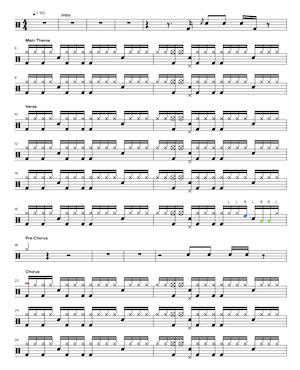
This printable drum score is recommended for intermediate players looking to improve pocket consistency, hand endurance, and clean hi hat control. It is highly valuable for funk drummers who want to master absolute rhythmic restraint and support a driving dance arrangement with confidence, precision, and steady timing.
Learn to play Stayin' Alive on drums
Play Stayin' Alive drum cover with our interactive drum sheet and synchronized video player. Follow every note in real time as the notation moves with the music, slow down challenging sections with tempo control, loop difficult grooves until they feel natural, and isolate the drum track to hear every detail of the steady four-on-the-floor rhythm. Whether you are building solid endurance with continuous disco-funk patterns or refining your precise hi-hat openings, our step-by-step learning tools make mastering this song faster, easier, and far more effective than practicing from a static PDF alone. Grab your drumsticks, lock into the steady pulse, and start practicing today!
Song information
Artist: Bee Gees
Drummer: Dennis Bryon
Album: Saturday Night Fever
Released: 1977
Sheet Music Details
Length
3 pages of highly readable, clean drum score layouts.
Tempo
100-109
Time Signature
4/4
Key features
Features a continuous four-on-the-floor disco groove, tight sixteenth-note hi-hat subdivisions, precise offbeat open hi-hat barks, minimalist fill transitions, and a demanding endurance test focusing on wrist relaxation and pocket consistency.
Song's Overview
Released in 1977 on the Saturday Night Fever soundtrack, "Stayin' Alive" fundamentally shaped the sound of the disco era and redefined the use of rhythm tracks in modern music production. Because of recording constraints at the time, the track features one of the first highly successful tape-looped drum performances, resulting in an unyielding, hypnotic precision that became a blueprint for dance music. To learn Stayin' Alive on drums, musicians must move past simple pop beats and study the exact micro-timing required to emulate a human machine.
The core arrangement relies heavily on a rock-solid four-on-the-floor bass drum pattern paired with crisp, driving sixteenth notes on the hi-hat. What makes studying this Stayin' Alive drum cover highly educational is mastering the syncopated hi-hat barks that add texture right before the snare backbeats on beats two and four. Working with an accurate Stayin' Alive drum sheet allows intermediate players to analyze how subtle dynamic control and a steady inner clock maintain the pocket without rushing the tempo. Ultimately, this exceptional piece of drumming demonstrates how absolute physical endurance and consistency can drive an entire arrangement, making the printable drum sheet an essential study for any groove-focused musician.
Dennis Bryon was the drummer for the Bee Gees during their record-breaking disco era. His unwavering, steady beat on "Stayin' Alive" is one of the most famous rhythms in pop history. He is a key study for anyone learning drums to master a perfectly consistent disco groove.
Drumming Style
His style is defined by a rock-solid, four-on-the-floor kick and a very tight hi-hat pattern. Playing drums like Bryon requires extreme precision and a "mechanical" consistency. His tracks are iconic choices for funky drum covers and foundational drum lessons on timing.
Practice Advice
01
Start Below Full Speed
The relentless sixteenth-note hi-hat pulse requires clean wrist articulation. Begin practicing at 90 BPM using tempo control to master hand-to-foot alignment before gradually building up to the original 104 BPM performance tempo.
02
Loop the Hi-Hat Openings
The groove features subtle offbeat open hi-hat barks right before the snare backbeat. Use loop mode to repeat these specific measures continuously, building muscle memory until the left-foot releases feel smooth and natural.
03
Avoid Overplaying the Space
A frequent mistake when learning this track is adding extra snare or tom fills. The original rhythm derives its heavy dance authority from absolute restraint. Prioritize an unyielding pocket and keep your fills minimal.
04
Ground Your Four-on-the-Floor Pulse
The bass drum plays steady quarter notes throughout the entire song layout. Practice regularly with a metronome to guarantee your foot remains unyielding and perfectly even, creating a hypnotic foundation for the bassline.
05
Master Sub-Division Dynamic Endurance
Sustaining continuous sixteenth notes can cause forearm fatigue. Focus on your push-pull wrist technique and keep your upper body relaxed to maintain even volume across the full arrangement without tensing up your muscles.
Learning Roadmap
Phase 1: Build Four-on-the-Floor Stamina
Isolate the continuous quarter-note bass drum foundation beneath a steady sixteenth-note hi-hat pattern. Practice this core layout slowly to build lower-body endurance and develop underlying coordination before adding the backbeat.
Phase 2: Integrate Precise Hi-Hat Barks
Incorporate the syncopated open-and-close hi-hat accents scattered across the main groove. Work on matching your left-foot release with the underlying pulse, ensuring these barks sound clean without altering your right-hand speed.
Phase 3: Perfect Minimalist Transition Fills
Analyze the sparse, crisp fills that connect the verses and choruses. Practice entering and exiting these transitions smoothly using tempo control tools to eliminate any rushing or rhythmic hesitation on the downbeat.
Phase 4: Execute the Full Arrangement Confidently
Combine all distinct phases and perform along with the complete drum transcription. Focus on maintaining upper-body relaxation across the 104 BPM tempo, driving the high-energy disco-funk pocket steadily from start to finish.
FAQ
Is Stayin' Alive suitable for beginners?
It’s more suited for beginners with some experience. Using features like tempo control and looping can help you learn it at your own pace.
Can I learn Stayin' Alive if I’m not very confident reading drum notation?
Yes — our interactive player makes it much easier. You can watch, listen, slow things down, and gradually get familiar with the notation as you play.
Do I need a full drum kit to play Stayin' Alive?
No — you don’t need a full drum kit to play Stayin' Alive. A basic setup (kick, snare, hi-hat) is enough to get started.
How will learning Stayin' Alive improve my drumming skills?
Stayin' Alive helps you develop a solid sense of groove and consistency. You’ll practice staying locked in with the beat while maintaining control over your dynamics.
What skills do I need before learning Stayin' Alive?
Before learning Stayin' Alive, it helps to be comfortable with basic grooves, simple fills, and maintaining steady timing.