

Have You Ever Seen The Rain

Have You Ever Seen The Rain
Drum Sheet Music

Practice Creedence Clearwater Revival on Drums

Easy

See How Drummer Tube Helps You Learn Songs Faster

Want access to all lessons?

View Plans >> Unlock this song – $7.90

Learn to Play Have You Ever Seen The Rain Faster With Pro Interactive Drum Player

Play Sample Song For Free

Master This Song

$7.90

Original + Simplified

  • Download both versions as drum sheet PDFs
  • Play along with both versions in the interactive player for 2 months
Buy This Song

One-time payment · No subscription

Original
Simplified

Choose your Drum Sheet Version

Two versions of the drum sheet - choose the one that fits your level and goals.

ORIGINAL VERSION
Difficulty Level:
Easy
  • Exactly as played on the original recording
  • All fills & ghost notes
  • Full arrangement
SIMPLIFIED VERSION
Difficulty Level:
Very Easy
  • Easier to learn
  • Simplified fills
  • Reduced ghost notes
  • Perfect for beginners & intermediates

Not sure which version?

We recommend starting with the Simplified Version and moving to the Original Version once you're comfortable with the groove and structure.

Unlock all songs library and practice like a pro:

$10 / month

Billed at $120 per year

  • 7-day free trial
  • Full access to all songs
  • Interactive player
  • Downloadable drum sheets
  • Full support
  • Cancel anytime
  • 30-day money-back guarantee

$15 / month

Billed at $15 per month

  • Full access to all songs
  • Interactive player
  • Downloadable drum sheets
  • Full support
  • Cancel anytime

Drumming Techniques You'll Learn in Have You Ever Seen The Rain

  • Mid-Tempo Rock Groove Consistency
  • Precise Hi-Hat Articulation Control
  • Minimalist Rhythmic Restraint and Spacing
  • Clean Sectional Transition Timing Accuracy
  • Solid Bass Drum Pulse Alignment

Recommended For

This drum notation is recommended for beginner to intermediate drummers looking to strengthen mid-tempo groove consistency and basic time-keeping precision. It is highly valuable for players interested in roots-rock drumming who want to master clean hi-hat control and develop the ability to support an arrangement with absolute restraint.

Learn to play Have You Ever Seen The Rain on drums

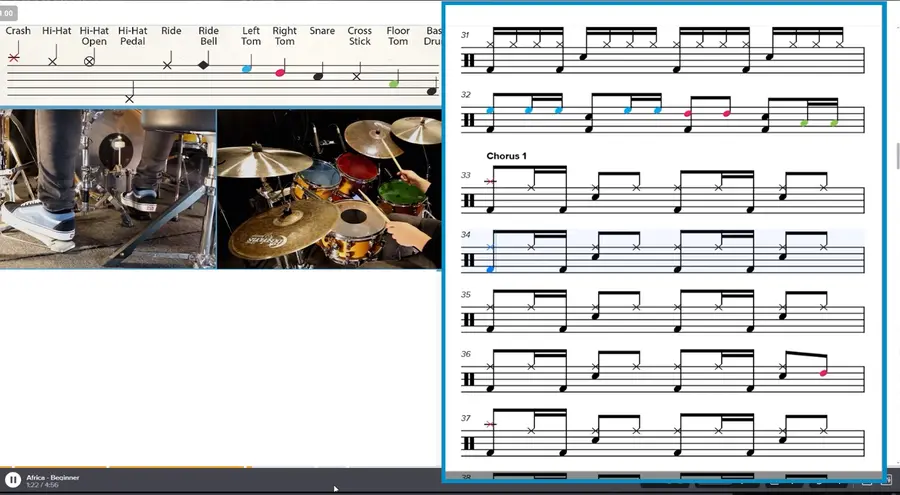
Play Have You Ever Seen the Rain? drum cover with our interactive drum sheet and synchronized video player. Follow every note in real time as the synchronized drum notation moves along with the audio track. Use tempo control to slow down Doug Clifford's steady quarter-note bass drum spacing, isolate the drum track using isolated drums to analyze his clean snare backbeats, and use looping sections to master the smooth transition fills leading into the chorus. Learning this track helps you develop exceptional mid-tempo pocket consistency and precise cymbal balance. Our step-by-step tools make studying this interactive drum sheet faster and far more effective than reading static layouts alone. Grab your sticks and lock into this classic roots-rock pulse today!

Song information

Artist: Creedence Clearwater Revival

Album: Pendulum

Released: 1970

Sheet Music Details

Length

2 pages of highly readable, clean drum score layouts.

Tempo

110-119

Time Signature

4/4

Key features

This complete drum transcription features a steady roots-rock pocket, precise eighth-note hi-hat patterns with subtle off-beat openings, and minimalist single-stroke transition fills. It tests your mid-tempo timing precision and groove consistency.

Song's Overview

Released in 1970 on Creedence Clearwater Revival's album Pendulum, Have You Ever Seen the Rain? stands as a defining example of roots-rock songwriting paired with a masterclass in understated rhythm section performance. The track is built around a melancholic acoustic guitar strum and a driving bassline that demands a steady, supportive rhythmic foundation to let the emotional weight of the vocal melodies shine through. For musicians who want to learn Have You Ever Seen the Rain? on drums, Doug Clifford’s performance provides an exceptional study in dynamic restraint and temporal spacing. Rather than cluttering the arrangement with complex fills or aggressive syncopation, the drumming relies on an unwavering eighth-note hi-hat pulse, crisp snare backbeats on beats two and four, and well-placed bass drum patterns that lock tightly with the bass guitar. Dissecting an accurate drum sheet reveals how small variations, such as subtle hi-hat openings or short single-stroke tom transitions, can effectively signal structural shifts in a pop-rock track. Studying a high-quality drum cover teaches drummers how to prioritize a rock-solid pocket over personal showcase, demonstrating that a disciplined groove is essential for driving a classic vocal arrangement.

See How Drummer Tube Helps You Learn Songs Faster

Want access to all lessons?

View Plans >> Unlock this song – $7.90

About the Drummer

Douglas "Cosmo" Clifford is the foundational drummer and co-founding member of the legendary American rock band Creedence Clearwater Revival (CCR). Nicknamed "Cosmo" for his early passion for nature and astronomy, Clifford provided the steady, metronomic beat that propelled CCR to global stardom in the late 1960s and early 1970s. His unshakeable timekeeping, powerful pocket, and economical playing helped define the sound of roots rock and Americana, proving that serving the song with unwavering solid grooves is one of the drummer's highest callings.

Drumming Style

Doug Clifford's drumming style is defined by driving simplicity, flawless timekeeping, and a deep pocket. Rather than overcomplicating tracks with complex fills or polyrhythms, Clifford focused on building an impenetrable rhythm section alongside bassist Stu Cook. His approach relies heavily on solid, accented hi-hat patterns, crisp snare backbeats on beats two and four, and steady bass drum patterns that drive the song forward.

He frequently utilized subtle hi-hat openings, steady ride cymbal pulses, and light secondary percussion, such as the cowbell, to give tracks distinct flavor. Clifford's masterclass in dynamic restraint allowed CCR's guitar riffs and vocals to shine, demonstrating how minimalist drumming can deliver maximum punch and emotional clarity.

Practice Advice

01
Start Below Full Tempo
The song's slow-to-mid-tempo pocket requires ultimate metric precision. Begin practicing at 90 BPM using tempo control. Focus on aligning your bass drum patterns perfectly with the metronome before accelerating to the original 116 BPM track velocity.
02
Loop the Chorus Re-entries
Pay close attention to the smooth transitions moving directly into the chorus sections. Use loop mode to isolate these bars, repeating the brief single-stroke fills until you can transition between patterns without disrupting the steady timing.
03
Avoid Rushing the Backbeat
A frequent mistake when learning this straightforward groove is letting the snare drift ahead of the beat. Keep your shoulder muscles loose and focus on dropping the backbeat squarely on beats two and four to maintain a relaxed pocket.
04
Strengthen Rhythmic Pocket Consistency
Lock your bass drum strikes seamlessly with the underlying bass guitar pattern. Practice keeping your foot velocity completely uniform across each measure, ensuring the low-end foundation remains stable beneath the acoustic guitar and vocal harmonies.
05
Master Subtle Hi-Hat Openings
The main drumming challenge is executing crisp hi-hat openings without altering your timing. Practice lifting your foot slightly on specific off-beats, ensuring the cymbal chokes tightly right on the following downbeat to keep the groove clean.

Learning Roadmap

Phase 1: Establish the Foundational Rock Pocket

Isolate the core verse groove on closed hi-hats. Focus on maintaining an even, steady eighth-note pulse with your dominant hand while locking your bass drum and snare cleanly together. Practice slowly to build foundational time-keeping stability.

Phase 2: Integrate Syncopated Hi-Hat Articulations

Introduce the subtle open hi-hat notes into the main rhythm. Work at a reduced tempo to ensure the left-foot pedal releases do not disturb your steady bass drum alignment or cause the overall tempo to rush.

Phase 3: Master the Sectional Transition Fills

Analyze the minimalist single-stroke fills that bridge the verses and choruses. Use looping features to isolate these transitional bars, ensuring you drop the fills in accurately and hit the following chorus downbeats with clean crash punctuation.

Phase 4: Perform Full Arrangement with Restraint

Combine all distinct phases and perform along with the complete audio track. Focus on managing your physical relaxation, breathing patterns, and unwavering groove consistency, driving the classic roots-rock pulse confidently from start to finish.

FAQ

What skill level is required to play Have You Ever Seen the Rain on drums?

This song is suitable for beginner to early-intermediate drummers. The primary groove is straightforward, making it an excellent choice for developing steady timing and song structure awareness.

What is the BPM of Have You Ever Seen the Rain?

The original studio recording by Creedence Clearwater Revival plays at approximately 116 BPM in a standard 4/4 time signature.

Who played drums on the original recording of Have You Ever Seen the Rain?

Doug 'Cosmo' Clifford played drums on the original 1970 studio recording for Creedence Clearwater Revival's album Pendulum.

What is the primary drumming challenge in this song?

The primary challenge is maintaining consistent quarter-note hi-hat dynamics and solid backbeat timing without rushing during section transitions.

Does the drum sheet include full drum notation?

Yes, our interactive drum sheet provides complete, note-for-note drum notation synchronized with audio playback and tempo controls.

Related songs

Pro Practice Feature

Still figuring this song out on your own?

Learn this drum cover faster with our interactive player:

Used by +1,000 drummers worldwide

Registr to start your Week Free Trial