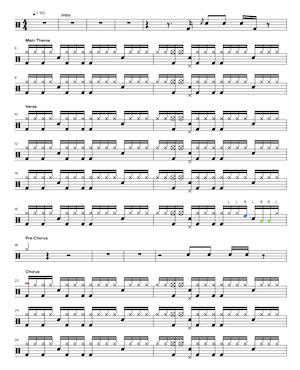
This drum sheet is recommended for beginner to intermediate drummers looking to strengthen their mid-tempo pocket consistency, basic timing precision, and overall musical restraint. It is especially valuable for players interested in roots-rock drumming and those who want to develop the physical discipline needed to support an easy-going country-rock arrangement with absolute clarity, confidence, and steady authoritative rhythmic precision across the entire track.
Learn to play Lodi on drums
Play Lodi drum cover with our interactive drum sheet and synchronized video player. Follow every steady beat in real time as the synchronized drum notation moves along with the audio track. Use tempo control to slow down Doug Clifford's country-rock pulse, select looping sections to master the subtle transitional fills, and use isolated drums to check your kick-to-snare balance. Learning this track helps you develop consistent mid-tempo pocket stability and clean hi-hat articulation. Our advanced tools make analyzing this drum transcription faster and far more effective than reading a static printable drum sheet alone. Grab your sticks and lock into this classic groove today!
Song information
Artist: Creedence Clearwater Revival
Drummer: Doug "Cosmo" Clifford
Album: Green River
Released: 1969
Sheet Music Details
Length
2 pages of highly readable, clean drum score layouts.
Tempo
120-129
Time Signature
4/4
Key features
This complete drum transcription features a steady country-rock pocket, straightforward single-stroke fills, clean ride cymbal variations, and a late key modulation. It tests mid-tempo timing precision, rhythmic restraint, and consistent backbeat dynamics.
Song's Overview
Released in 1969 as the B-side to "Bad Moon Rising" and later featured on the Green River album, "Lodi" stands as a foundational track for the late-1960s roots-rock and country-rock movements. Built around John Fogerty’s storytelling lyrics and a chord progression that modulates late in the song, the track relies on an easy-going but steady pulse to drive its melancholic narrative.
For anyone who wants to learn Lodi on drums, Doug Clifford’s performance provides an absolute masterclass in playing with a relaxed, deep pocket. The song features a classic straight-eight time-keeping pattern that avoids unnecessary complexity, demonstrating how a solid drumming backbone can ground a guitar-driven arrangement. The primary challenge within this Lodi drum sheet is keeping the time rock-solid without rushing the moderately slow tempo. While the patterns might seem straightforward, executing a convincing Lodi drum cover requires clean hi-hat subdivisions and uniform snare backbeats that lock perfectly with the bassline. Studying this specific piece reveals how subtle variations in fill placement and sharp crash placements lift the arrangement, proving that musical restraint is an indispensable asset when mastering a roots-rock groove.
Doug Clifford is the legendary "human metronome" for Creedence Clearwater Revival. His "swamp rock" beats are foundational for the American rock sound. He is a key influence for those learning drums who want to master the art of a steady, unwavering groove.
Drumming Style
Clifford’s style is direct, powerful, and intentionally simple to support the song’s narrative. Playing drums to CCR tracks requires consistent kick drum work and a solid, driving hi-hat. His parts are essential for beginner drum lessons and provide a perfect starting point for classic rock drum covers.
Practice Advice
01
Lock the Laid-Back Tempo
The track runs at roughly 126 BPM, which requires clean, unhurried precision. Use tempo control to practice at 100 BPM first. Focus on keeping your hand strokes relaxed and perfectly synchronized with the click to prevent rushing the open spaces.
02
Loop the Key Change Transition
The song features a distinct modulation late in the arrangement where it pitches up. Use looping sections to practice this specific shift repeatedly, ensuring your entry fill maintains the exact same micro-timing grid despite the key change.
03
Avoid Rushing the Fills
A frequent mistake on straightforward rock tracks is pushing transition fills ahead of the beat. Keep your forearm muscles loose and actively count the subdivisions in your head to ensure you drop back into the main pocket cleanly.
04
Maintain Strict Pocket Consistency
Lock your bass drum patterns cleanly with the driving bassline. Practice regular quarter-note and eighth-note pulses with a metronome, ensuring your foot hits land with identical dynamic weight to ground the song's rhythmic low end securely.
05
Master Smooth Ride Subdivisions
During the choruses, the groove expands onto the ride cymbal. Work on your right-hand articulation slowly to keep your stick strokes entirely even, preventing the continuous cymbal texture from overpowering the snare drum backbeat.
Learning Roadmap
Phase 1: Establish the Straight-Eight Pocket
Isolate the primary verse rhythm on the closed hi-hat. Focus on building clean, relaxed coordination between your right-hand subdivisions and straightforward kick-and-snare patterns at a slow, manageable tempo to lay down the foundational rhythm.
Phase 2: Master the Sectional Transition Fills
Analyze the minimalist single-stroke fills used to bridge the verses and choruses. Practice entering and exiting each phrase smoothly, ensuring your hands return to the main groove without hesitating or altering your underlying time-keeping grid.
Phase 3: Manage the Late Modulation Shift
Focus on the dynamic key change near the end of the song. Use targeting tools to practice the transition bar cleanly, ensuring you handle the arrangement lift smoothly while keeping your pocket completely grounded.
Phase 4: Perform Full Arrangement with Restraint
Combine all distinct sections and play along with the full song. Maintain complete focus on steady breathing, consistent backbeat dynamics, and precise micro-timing accuracy from the opening acoustic intro to the final, clean outro hit.
FAQ
Is Lodi suitable for beginners?
It’s more suited for beginners with some experience. Using features like tempo control and looping can help you learn it at your own pace.
Can I learn Lodi if I’m not very confident reading drum notation?
Yes — our interactive player makes it much easier. You can watch, listen, slow things down, and gradually get familiar with the notation as you play.
Do I need a full drum kit to play Lodi?
While some fills may require toms or cymbals, the core of Lodi can be practiced on a smaller kit.
How will learning Lodi improve my drumming skills?
By learning Lodi, you’ll work on coordination between your hands and feet, as well as transitions between grooves and fills.
What skills do I need before learning Lodi?
Before learning Lodi, it helps to be comfortable with basic grooves, simple fills, and maintaining steady timing.