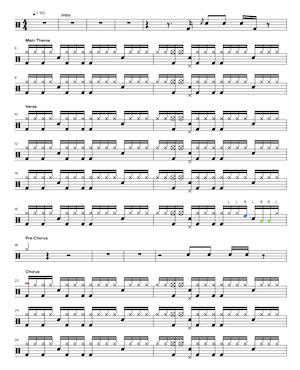
Drumming Techniques You'll Learn in You Can Leave Your Hat On
Mid-Tempo Groove Consistency
Precise Backbeat Note Placement
Rhythm Section Pocket Control
Syncopated Horn Accent Coordination
Micro-Timing and Restraint Development
Recommended For
This drum notation is recommended for intermediate drummers wanting to develop solid pocket control and steady timing. It is perfect for players looking to study the art of rhythmic restraint, master slow tempo consistency, and learn how to accurately align accents with a heavy blues pop horn section.
Learn to play You Can Leave Your Hat On on drums
Play You Can Leave Your Hat On drum cover with our interactive drum sheet player. Follow every note in real time as the synchronized drum notation moves with the music, slow down challenging tempos with tempo control, use looping sections to master difficult phrases, and listen to the isolated drums to hear every subtle nuance. Whether you are building confidence with slow pocket fundamentals or refining your groove consistency, these step-by-step tools make learning this track faster and more effective than a static printable drum sheet. Grab your sticks and start practicing!
Song information
Artist: Joe Cocker
Drummer: Mike Baird
Album: Cocker
Released: 1986
Sheet Music Details
Length
2 pages of highly readable, clean drum score layouts.
Tempo
80-89
Time Signature
4/4
Key features
Features a heavy mid-tempo rock groove, precise backbeat execution, syncopated accent placements that align with the brass section, and clean, powerful transitions that challenge a drummer's internal clock and micro-timing consistency.
Song's Overview
Originally written by Randy Newman, Joe Cocker’s 1986 version of "You Can Leave Your Hat On" transformed the track into a standout example of mid-tempo blues-rock and pop production, famous for its gritty vocal delivery and powerful brass arrangements. The song is heavily driven by its deliberate, slow swagger, creating a deep pocket that allows the horn stabs to command the arrangement.
To learn You Can Leave Your Hat On on drums, a player must shift focus away from speed and channel energy entirely into precise note placement and endurance. The drumming is characterized by a heavy, unyielding backbeat on beats two and four, punctuated by tight hi-hat work and subtle bass drum syncopations that align with the bassline. Studying a You Can Leave Your Hat On drum cover reveals how crucial micro-timing is; rushing even slightly destroys the laid-back tension that defines the track. By practicing with an accurate You Can Leave Your Hat On drum sheet, drummers can analyze how the rhythmic spacing keeps the arrangement feeling heavy without overcrowding the music. It serves as an excellent lesson in restraint, demonstrating that a solid foundation is what drives the performance.
Mike Baird is a prolific session drummer who has recorded with countless icons, including Joe Cocker, Hall & Oates, and Journey. He is known for his incredible "pocket" and his ability to fit into any musical genre perfectly. He is a primary model for anyone learning drums who wants to become a professional session player.
Drumming Style
His style is characterized by a "deep" groove and a very musical approach to supporting the song's arrangement. Playing drums like Baird teaches the importance of consistency, touch, and restraint. His work is a "gold standard" for those attempting professional-level drum covers and session-style drum lessons.
Practice Advice
01
Master the Slow Tempo
The groove moves at a deliberate, laid-back pace of around 86 BPM. Use tempo control to practice at 70-75 BPM first. Focus on keeping your snare hits exactly on beats two and four without letting the wide open space cause you to rush.
02
Loop the Brass Accents
Identify the sections where the drums catch the syncopated horn stabs. Use looping sections to isolate these specific bars and repeat them until your bass drum and crash hits lock perfectly with the horn section without disrupting the track's forward momentum.
03
Avoid Rushing the Backbeat
A frequent mistake here is letting the slow tempo drive you to play ahead of the beat, especially during the chorus. Keep your hands relaxed and intentional. Focus on playing behind the click to preserve the song’s signature heavy, dragging feel.
04
Lock with the Bassline
Timing consistency relies on your bass drum mirroring the bass guitar's rhythmic pulses. Practice along with a metronome or the drum transcription, ensuring your right foot lands precisely on the downbeats to create a seamless, cohesive pocket throughout the arrangement.
05
Refine Hi-Hat Dynamic Control
The main challenge is keeping the eighth-note hi-hat pattern driving but controlled. Avoid playing them too loudly; instead, maintain a steady, smooth dynamic level that provides a crisp foundation for the heavy snare backbeat to cut through cleanly.
Learning Roadmap
Phase 1: Master the Core Rock Pocket
Isolate the main verse groove, focusing on the slow eighth-note hi-hats and heavy snare backbeats. Practice slowly with a metronome to establish a steady, unhurried pulse, ensuring your bass drum notes line up accurately with the straightforward time signature.
Phase 2: Syncopate with the Horn Section
Analyze the brass-driven sections where the rhythm pushes against the downbeat. Practice transitioning smoothly into these specific accents without shifting your overall tempo, ensuring the fills and hits feel completely integrated into the foundational drum score layout.
Phase 3: Manage Dynamic Builds and Fills
Work through the choruses and bridges where the track's energy expands. Focus on executing the straightforward drum fills with confidence and power while maintaining absolute control over your volume so you do not accidentally overpower the musical arrangement.
Phase 4: Perform the Full Arrangement Confidently
Combine all distinct phases and play along with the complete audio track. Monitor your timing consistency from the opening beat to the final fade-out, building the physical endurance needed to sustain a slow, heavy pocket without losing focus.
FAQ
Is You Can Leave Your Hat On suitable for beginners?
You Can Leave Your Hat On is better suited for intermediate to advanced drummers. However, it can be a great long-term goal as your skills improve.
Can I learn You Can Leave Your Hat On if I’m not very confident reading drum notation?
It’s possible to learn You Can Leave Your Hat On by ear, especially if you break it into sections. Over time, you’ll also improve your ability to read drum notation.
Do I need a full drum kit to play You Can Leave Your Hat On?
No — you don’t need a full drum kit to play You Can Leave Your Hat On. A basic setup (kick, snare, hi-hat) is enough to get started.
How will learning You Can Leave Your Hat On improve my drumming skills?
Learning You Can Leave Your Hat On with an interactive player allows you to break the song into sections, slow it down, and truly understand every part — helping you improve faster and more efficiently.
What skills do I need before learning You Can Leave Your Hat On?
Even if you’re still developing these skills, you can learn You Can Leave Your Hat On step by step by slowing it down and practicing in sections.