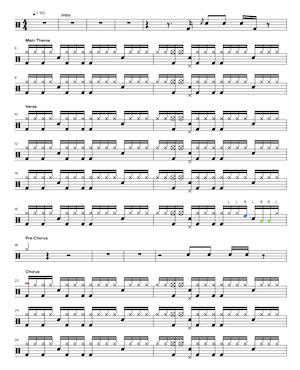
This drum notation is recommended for intermediate to advanced drummers seeking to master polyrhythmic pocket control and deep metric stability. It provides exceptional training for players focused on heavy rock timing, helping them develop the limb independence and restraint necessary to anchor complex instrumental arrangements with absolute confidence.
Learn to play Kashmir on drums
Play Kashmir drum cover with our interactive drum sheet and synchronized video player. Follow John Bonham's distinct halftime pulse in real time as the notation moves with the track, or use tempo control to slow down the complex polyrhythmic sections where the 4/4 drum beat superimposes against the 3/4 orchestral phrasing. Isolate the drums to dissect the heavy bass drum placement, and use looping sections to repeat the hypnotic main groove until it feels deeply locked. Our interactive drum sheet transforms this extensive track into manageable parts, helping you master independent pocket control and metric pacing more effectively than a standard PDF drum sheet. Grab your sticks and start driving this thunderous pattern today!
Song information
Artist: Led Zeppelin
Drummer: John Bonham
Album: Physical Graffiti
Released: 1975
Sheet Music Details
Length
4 pages of highly readable, clean drum score layouts.
Tempo
80-89
Time Signature
4/4
Key features
Features a steady halftime rock pocket juxtaposed against cross-rhythmic phrases, explicit triplet fill notations, detailed open hi-hat aperture markings, and sustained linear kick drum patterns requiring exceptional precision and dynamic restraint.
Song's Overview
Released in 1975 on the Physical Graffiti album, the track holds a unique position in heavy rock music due to its pioneering structural concept. The song's defining feature is a rare metric tension: while the strings and guitars cycle through an ascending riff in a triple meter pattern (3/4 time), the drumming maintains a steadfast, heavy quadruple meter (4/4 time). This juxtaposition creates a fascinating phase-shifting relationship that resolves every few bars, providing a blueprint for modern progressive rock and rhythmic integration.
To learn Kashmir on drums is to understand the absolute power of restraint and micro-timing. Rather than cluttering the space with busy fills, the performance relies on an unyielding, open hi-hat wash and an incredibly heavy bass drum thump that anchors the swirling arrangement. When tackling a Kashmir drum cover, musicians must master the art of playing behind the beat, deliberate dragging, and precise snare backbeats that ground the entire ensemble. The space between the notes gives the piece its monumental, sweeping scale. Utilizing a detailed Kashmir drum sheet allows drummers to visualize this complex polyrhythmic grid, helping them cultivate deep physical pacing, heavy dynamic control, and an unshakeable sense of internal timing.
John "Bonzo" Bonham was the powerhouse behind Led Zeppelin and is widely cited as the most influential rock drummer in history. His work is a core component of any advanced drum lessons curriculum because of his revolutionary sound and technique. Every serious musician learning drums eventually studies his legendary tracks to understand true rock power.
Drumming Style
Bonham’s style is famous for its massive "behind the beat" groove, incredible right-foot speed, and heavy use of triplets. Playing drums to his music requires a mastery of dynamics and a deep understanding of internal "swing" within a rock context. His tracks are among the most challenging and rewarding options for anyone producing professional drum covers.
Practice Advice
01
Internalize the Metric Contrast Slower
The track’s overlapping meters can easily throw off your timing. Begin practicing the core 4/4 drum rhythm against a metronome at 60 BPM. Focus completely on the straight pulse without listening to the 3/4 melody until your hands can maintain the pattern automatically.
02
Loop the Bridge Transitions
The transitions leading into the ascending bridge sections require sharp phrase awareness. Use loop mode to repeat these shifting sections over and over. This deliberate repetition builds muscle memory, ensuring your fills exit smoothly back into the heavy, driving verse groove.
03
Avoid Rushing the Pocket
A frequent mistake drummers make here is pushing the tempo or rushing the snare backbeat. John Bonham's distinct feel relies on sitting heavily behind the beat. Resist the urge to speed up during the long, repetitive patterns by anchoring your left hand on beat two and four.
04
Lock into the Halftime Feel
To maintain perfect consistency across this eight-minute arrangement, your hi-hat notes must remain completely uniform. Practice with a subdivision click track, ensuring your bass drum hits perfectly lock with the main pulse to develop an ironclad rock pocket.
05
Master Open Hi-Hat Consistency
The signature element of this groove is the loose, sloshy open hi-hat sound that remains controlled. Work on keeping your hi-hat foot slightly open at a constant height, preventing the cymbals from choking or becoming too loud and overriding the snare.
Learning Roadmap
Phase 1: Lock Down the 4/4 Halftime Foundation
Isolate the primary verse beat, concentrating strictly on the open hi-hat wash and heavy kick-snare coordination. Work with a metronome to keep your limbs steady, ensuring you can play a continuous, unwavering rock pocket completely independent of any melodic distractions.
Phase 2: Navigate the Counter-Rhythmic Phrasing
Introduce the tracking melody against your straight 4/4 groove. Focus on the tension where the instrumental riff cycles in three while your hands count in four, training your brain to resist pulling toward the guitar's accents and maintaining a solid rhythmic grid.
Phase 3: Execute the Orchestral Fill Transitions
Break down the triplet-based fills and sudden pauses scattered between the major structural shifts. Practice entering and exiting these fills cleanly, ensuring your physical movement across the kit does not disrupt your internal clock or cause the next verse downbeat to falter.
Phase 4: Build Endurance for the Full Arrangement
Combine all individual parts and play along with the full eight-minute track. Focus on physical relaxation, breath control, and dynamic balance, ensuring your snare backbeat retains its authoritative, heavy resonance from the opening count to the slow fading outro.
FAQ
Is Kashmir suitable for beginners?
Kashmir is better suited for intermediate to advanced drummers. However, it can be a great long-term goal as your skills improve.
Can I learn Kashmir if I’m not very confident reading drum notation?
It’s possible to learn Kashmir by ear, especially if you break it into sections. Over time, you’ll also improve your ability to read drum notation.
Do I need a full drum kit to play Kashmir?
No — you don’t need a full drum kit to play Kashmir. A basic setup (kick, snare, hi-hat) is enough to get started.
How will learning Kashmir improve my drumming skills?
Kashmir challenges you in a musical way, helping you improve not just technique, but also your ability to play with feel, structure, and confidence.
What skills do I need before learning Kashmir?
To learn Kashmir, you’ll need solid timing, good coordination, and experience with more complex drum patterns.