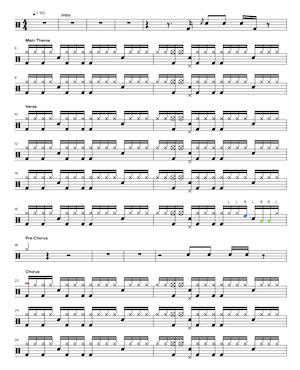
This drum transcription is recommended for intermediate to advanced drummers aiming to master odd time signatures and complex metric modulations. It is highly beneficial for rock players seeking to develop a relaxed swing feel, improve rhythmic precision, and learn how to transition seamlessly between asymmetrical and symmetrical grooves with confidence.
Learn to play Money on drums
Play Money drum cover with our interactive drum sheet and advanced practice tools designed for progressive rock. Navigating Nick Mason's distinctive 7/4 time signature requires precision, and our synchronized drum notation helps you track each beat in real-time. Use tempo control to slow down the complex shifting rhythms, lock in the swung eighth-note groove, and utilize looping sections to master the transition into the 4/4 guitar solo. By utilizing the isolated drums feature, you can analyze every snare placement and snare dynamic. This comprehensive toolkit accelerates your ability to learn drums, navigate odd times, and improve your overall limb independence. Grab your sticks and start mastering this rhythmic masterpiece today!
Song information
Artist: Pink Floyd
Drummer: Nick Mason
Album: The Dark Side of the Moon
Released: 1973
Sheet Music Details
Length
4 pages of highly readable, clean drum score layouts.
Tempo
120-129
Time Signature
4/4, 7/4
Key features
Features a detailed transcription of the signature 7/4 swung groove, clear notation for the 4/4 time signature transitions, and step-by-step layouts of Nick Mason's syncopated fills and solo phrasing.
Song's Overview
Released in 1973 on Pink Floyd's album The Dark Side of the Moon, this track stands out as a defining piece in progressive rock, famously proving that an odd time signature can captivate a mainstream audience. The song is anchored by an unusual 7/4 time signature, driven initially by a cash register sound loop that establishes a concrete loop for the band to follow. For drummers looking to learn Money on drums, the track presents an engaging study in rhythmic phrasing and time signature transitions. Drummer Nick Mason delivers a masterclass in restraint and groove, locking down a bluesy, swung eighth-note feel that prevents the 7/4 meter from sounding forced or awkward. One of the most critical elements of the drumming arrangement is the sudden shift to a standard 4/4 groove during the extended saxophone and guitar solos, before smoothly pivoting back to the original seven-beat frame. This structural shift requires excellent internal clock control and musical awareness.Studying a money drum sheet allows players to look closely at Mason’s clever fills, which often cross over bar lines to navigate the asymmetrical time signature. Ultimately, creating a Money drum cover challenges your ability to maintain a rock-solid pocket while executing odd-time phrasing seamlessly.
Nick Mason is a founding member of Pink Floyd and a master of atmospheric and progressive drumming. He is famous for his ability to use space and texture to elevate complex musical themes. Every student learning drums in the prog-rock genre studies his iconic parts.
Drumming Style
Mason’s style is subtle and measured, often focusing on steady, slow-tempo grooves that allow the guitars to breathe. Playing drums to his tracks involves mastering dynamics and a very precise sense of time. His work on "Money" (in 7/4 time) is a legendary challenge in drum lessons and for technical drum covers.
Practice Advice
01
Start Slow in Seven
The original track sits around 120 BPM. Begin your metronome practice at 90 BPM to internalize the asymmetrical 7/4 meter. Focus on counting the seven quarter-note beats clearly before attempting the full track speed to ensure your limbs place the backbeat cleanly.
02
Loop the Time-Signature Changes
Isolate the bars where the song shifts from 7/4 to 4/4 for the guitar solo, and back again. Use looping tools to repeat these specific transitions until your internal clock handles the expanding and contracting measures smoothly without rushing.
03
Mind the Swung Eighths
A frequent pitfall is playing the eighth notes straight. Nick Mason uses a distinct, relaxed swing feel throughout the main groove. Avoid rushing the late eighth notes, particularly on the hi-hat, to prevent the pocket from sounding stiff.
04
Lock into the Cash Loop
Keep your bass drum and snare perfectly aligned with the driving bassline and the implied cash register rhythm. Focus on keeping your quarter-note pulse unshakeable, treating the unusual meter with the same steady consistency you would bring to a standard blues rock pocket.
05
Navigate Fills Across Bar Lines
Mason’s fills often stretch across the 7/4 frame, which can easily disorient your timing. Practice these fills slowly, paying attention to where the downbeat lands in the following measure, ensuring you exit each phrase cleanly on beat one.
Learning Roadmap
Phase 1: Internalize the Basic 7/4 Groove
Isolate the primary verse rhythm. Practice playing a relaxed, swung eighth-note pattern on the hi-hat while matching your kick and snare drops to the famous seven-beat bassline. Master this loop slowly until counting to seven becomes second nature.
Phase 2: Transition Fluently Between Meters
Focus on the structural shifts into the 4/4 guitar solo and back into 7/4. Practice entering and exiting these sections cleanly, ensuring your brain and limbs instantly adjust to the changing length of each measure without losing the pulse.
Phase 3: Smooth Out Odd-Meter Drum Fills
Analyze the fills Nick Mason plays during the verses and the solo breakdown. Practice executing these phrases slowly, ensuring you accurately track the downbeat of the next measure, as fills in 7/4 can easily disrupt your timing.
Phase 4: Build Endurance and Full Arrangement Flow
Combine all individual parts to perform the complete song. Focus on maintaining a deep, relaxed pocket across the full six minutes, managing your dynamics during the softer saxophone phrases and elevating your energy during the intense guitar solo.
FAQ
Is Money suitable for beginners?
Money is better suited for intermediate to advanced drummers. However, it can be a great long-term goal as your skills improve.
Can I learn Money if I’m not very confident reading drum notation?
Money involves more complex patterns, so reading drum notation will make the learning process much easier and faster.
Do I need a full drum kit to play Money?
Yes — to fully play Money as recorded, a full drum kit is recommended due to the use of multiple toms and cymbals.
How will learning Money improve my drumming skills?
Learning Money with an interactive player allows you to break the song into sections, slow it down, and truly understand every part — helping you improve faster and more efficiently.
What skills do I need before learning Money?
Money requires control over dynamics, transitions, and more advanced techniques, so it’s best suited for intermediate to advanced drummers.