

Where Is My Mind

Where Is My Mind
Drum Sheet Music

Practice Pixies on Drums

Intermediate

See How Drummer Tube Helps You Learn Songs Faster

Want access to all lessons?

View Plans >> Unlock this song – $7.90

Learn to Play Where Is My Mind Faster With Pro Interactive Drum Player

Play Sample Song For Free

Master This Song

$7.90

Original + Simplified

  • Download both versions as drum sheet PDFs
  • Play along with both versions in the interactive player for 2 months
Buy This Song

One-time payment · No subscription

Original
Simplified

Choose your Drum Sheet Version

Two versions of the drum sheet - choose the one that fits your level and goals.

ORIGINAL VERSION
Difficulty Level:
Intermediate
  • Exactly as played on the original recording
  • All fills & ghost notes
  • Full arrangement
SIMPLIFIED VERSION
Difficulty Level:
Easy
  • Easier to learn
  • Simplified fills
  • Reduced ghost notes
  • Perfect for beginners & intermediates

Not sure which version?

We recommend starting with the Simplified Version and moving to the Original Version once you're comfortable with the groove and structure.

Unlock all songs library and practice like a pro:

$10 / month

Billed at $120 per year

  • 7-day free trial
  • Full access to all songs
  • Interactive player
  • Downloadable drum sheets
  • Full support
  • Cancel anytime
  • 30-day money-back guarantee

$15 / month

Billed at $15 per month

  • Full access to all songs
  • Interactive player
  • Downloadable drum sheets
  • Full support
  • Cancel anytime

Drumming Techniques You'll Learn in Where Is My Mind

  • Hi-Hat Dynamic Control
  • Alternative Rock Pocket Consistency
  • Restraint and Fill Placement
  • Precise Kick-Snare Alignment
  • Steady Tempo Endurance

Recommended For

This drum sheet is recommended for beginner to intermediate drummers looking to strengthen groove consistency, micro-dynamic control, and overall pocket precision. It is especially valuable for players wanting to develop the discipline of supporting an alternative rock arrangement with confidence, structural restraint, and steady timekeeping.

Learn to play Where Is My Mind on drums

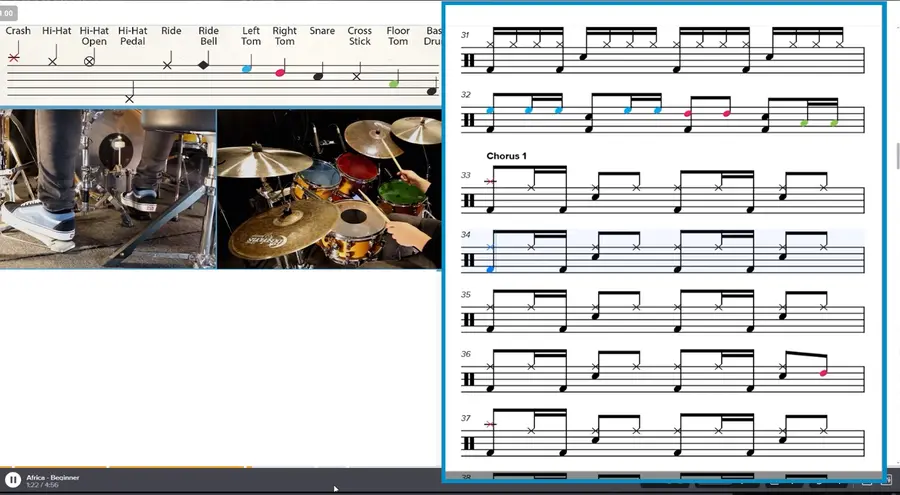
Play Where Is My Mind? drum cover with our interactive drum sheet and synchronized video player. Follow every note in real time as the notation moves with the music, slow down challenging sections with tempo control, loop difficult grooves until they feel natural, and isolate the drum track to hear every detail of David Lovering's precise performance. Whether you're mastering alternative rock pocket or refining your open hi-hat dynamic control, our step-by-step learning tools make mastering this track faster, easier, and far more effective than practicing from a static PDF alone. Grab your sticks and lock into this mesmerizing groove today!

Song information

Artist: Pixies

Drummer: David Lovering

Album: Surfer Rosa

Released: 1988

Sheet Music Details

Length

2 pages of highly readable, clean drum score layouts.

Tempo

80-89

Time Signature

4/4

Key features

Features a steady alternative rock groove, precise hi-hat dynamic transitions, sparse tom fills, and a strong emphasis on consistent pocket timekeeping. Ideal for mastering controlled backbeats and micro-dynamics within a repetitive song structure.

Song's Overview

Released in 1988 on the Pixies' album Surfer Rosa, Where Is My Mind? became a foundational track for the alternative rock movement, influencing a generation of musicians with its distinct loud-quiet dynamic shifts. Built around a haunting acoustic guitar riff and a prominent bassline, the song relies on a steady, hypnotic rhythm to anchor its surreal atmosphere. For drummers, to learn Where Is My Mind? on drums is an exercise in restraint and precision. David Lovering's drumming provides the essential backbone, steering clear of flashy fills to focus entirely on locking into the pocket. The track demonstrates how subtle variations—like shifting between tight and slightly open hi-hats—can dramatically alter the energy of a section without changing the underlying beat. Studying this Where Is My Mind? drum cover reveals how vital consistent timekeeping is when supporting space-heavy guitar arrangements. Decades later, this track remains a textbook study in alternative rock groove construction. Utilizing a comprehensive Where Is My Mind? drum sheet allows players to dissect Lovering’s subtle accent choices and steady kick-snare placement, ensuring you capture the authentic feel of this performance.

See How Drummer Tube Helps You Learn Songs Faster

Want access to all lessons?

View Plans >> Unlock this song – $7.90

About the Drummer

David Lovering is the drummer for the alternative rock legends Pixies, known for his steady and tasteful playing. His work helped define the "loud-quiet-loud" dynamic that influenced bands like Nirvana and Radiohead. He is a respected figure for students learning drums for his musical and supportive approach.

Drumming Style

His style is minimalist and precise, often featuring driving eighth-note patterns on the hi-hat and snare. Playing drums along to "Where Is My Mind" requires a steady hand and an understanding of the song's atmospheric dynamics. His parts are staples for alternative rock drum covers and foundational drum lessons.

Practice Advice

01
Start Below Full Speed
The song's laid-back groove requires exceptional precision. Start practicing at 70–75 BPM before moving to the full tempo. Focus on the exact placement of the bass drum hits relative to your hi-hat to build muscle memory.
02
Loop the Verse Transitions
Pay close attention to where the verses transition into the wider chorus sections. Use loop mode to repeat these bars, ensuring your transition from tight hi-hats to sloshy open hi-hats happens smoothly without rushing the tempo.
03
Avoid Overplaying the Fills
A common mistake is adding complex fills during the spacious choruses. David Lovering's parts are effective because they are sparse and deliberate. Resist the urge to overplay and keep your fills simple and perfectly in time.
04
Lock the Pocket Consistent
Develop timing consistency by practicing with a metronome or an isolated track. Focus on the alignment of your snare on beats two and four, ensuring it lands squarely in the center of the pocket throughout the arrangement.
05
Control Open Hi-Hat Dynamics
The primary challenge here is managing the hi-hat texture. Practice opening the hi-hat just enough to sizzle during the chorus, then quickly crisping it back up for the verse. Keep this movement controlled and dynamically balanced.

Learning Roadmap

Phase 1: Master the Foundational Verse Groove

Isolate the main verse rhythm, focusing on a steady eighth-note pattern on the hi-hat and a solid backbeat. Practice slowly to ensure perfect synchronization between your hands and feet before speeding up.

Phase 2: Transition Between Hi-Hat Textures

Work on the chorus sections where the hi-hat opens up. Practice smoothly transitioning from a tight, controlled sound in the verse to a washing, louder texture in the chorus without altering your physical tempo.

Phase 3: Smooth Out Simple Fill Transitions

Analyze the minimal tom and snare fills scattered between sections. Practice entering and exiting these brief fills cleanly, ensuring your hands return to the primary groove smoothly on the downbeat without halting the song's momentum.

Phase 4: Maintain Full Arrangement Endurance

Combine all sections and play along with the full track. Focus on emotional restraint, dynamic control, and steady timekeeping, ensuring your groove remains entirely locked in from the opening counts to the final fade-out.

FAQ

What is the skill level required to play Where Is My Mind on drums?

This song is ideal for beginner to early-intermediate drummers. The core beat is straightforward, making it accessible while teaching essential skills like timing control and dynamics.

What tempo is Where Is My Mind played at?

The song is recorded at a steady mid-tempo pace of approximately 81 BPM in a standard 4/4 time signature.

What is the main drumming challenge in this song?

The biggest challenge is controlling dynamic volume shifts between the quiet verses and loud choruses while maintaining a perfectly steady tempo without rushing.

Do I need a double bass pedal to play this drum sheet?

No, the song requires only a standard single bass drum pedal setup and basic drum kit components.

Does the drum score include full drum notation for all fills?

Yes, the drum sheet accurately transcribes all kick, snare, hi-hat, and cymbal crash patterns note-for-note as recorded on the original studio album.

Related songs

Pro Practice Feature

Still figuring this song out on your own?

Learn this drum cover faster with our interactive player:

Used by +1,000 drummers worldwide

Registr to start your Week Free Trial