

 Drum It Original
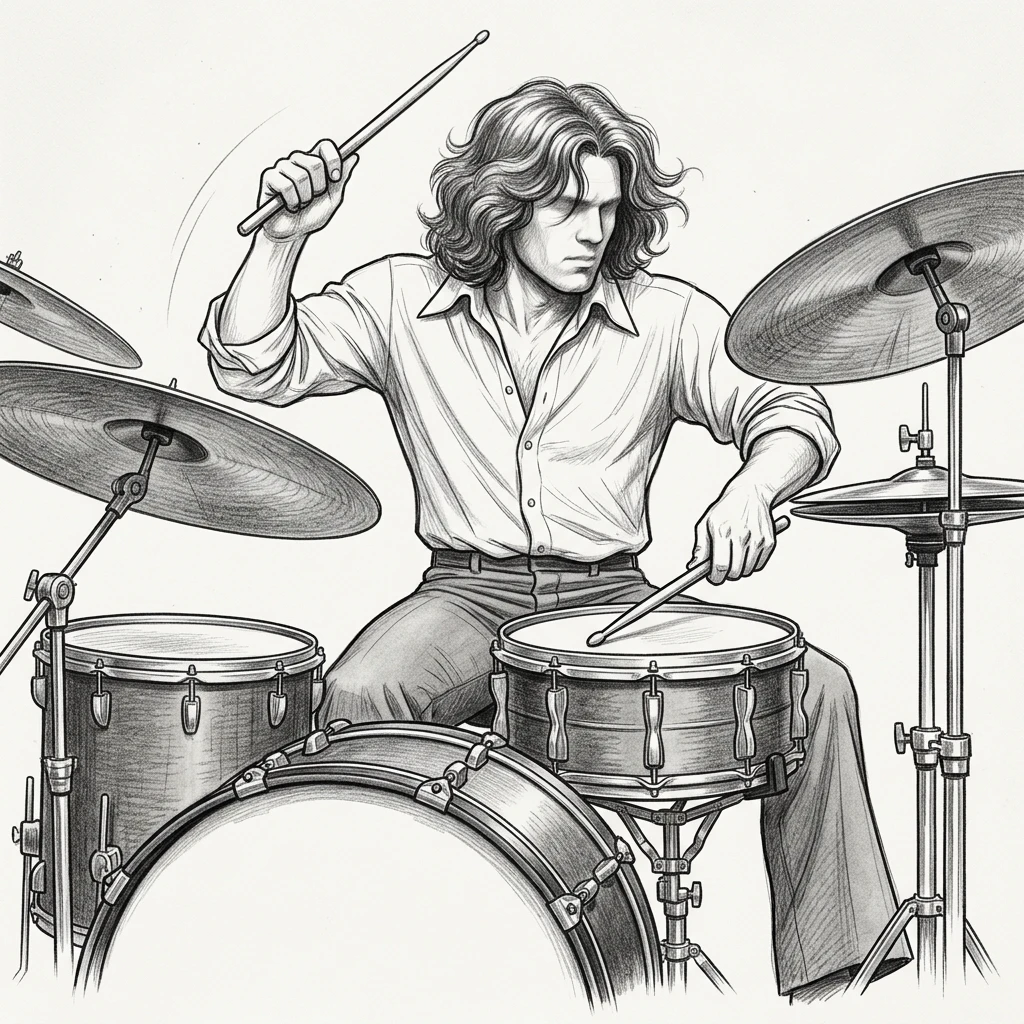
About the drummer
John Bonham was the legendary English drummer for the iconic rock band Led Zeppelin. Widely regarded as one of the most influential and technically proficient drummers in rock history, Bonham transformed hard rock drumming with his immense power, flawless sense of groove, and unmatched right-foot speed. His signature sound combined heavy hitting with deep, swing-influenced dynamics derived from his jazz and R&B roots. Bonham's groundbreaking work defined the sonic landscape of 1970s rock and continues to serve as an essential benchmark for feel, power, and musical presence behind the kit.
Drum It Original
Drum It Simplified
 Drum It Original
Drum It Simplified
 Drum It Original
Drum It Simplified
 Drum It Original
Drum It Simplified
 Drum It Original
Drum It Simplified
 Drum It Original
Drum It Simplified
Drumming style
John Bonham's drumming style was defined by a unique combination of explosive volume, deep pocket, and fluid syncopation. Rooted in big band jazz and American R&B, he possessed an uncanny ability to push and pull the tempo, creating a heavy, laid-back feel that gave Led Zeppelin's music its signature swing. Bonham utilized extreme dynamic contrast, transitioning effortlessly from thunderous rimshots to subtle, unaccented ghost notes. His bass drum foot was legendary for its speed and precision using a single pedal, often weaving complex triplet patterns around guitar riffs. Rather than merely keeping time, Bonham played off the bass lines to craft complex, melodic rhythms that drove the band's arrangements.
Bonham developed an astonishingly quick right foot, executing rapid triplet figures on a single bass drum pedal that rivaled double-bass players.
He consistently laid back on the beat, giving his grooves a relaxed yet heavy momentum without slowing the tempo.
Bonham disguised intricate sub-grooves within heavy patterns by using subtle, low-volume snare ghost notes between explosive accents.
In extended live solos, he famously set aside his sticks to play intricate rhythms directly on the drumheads using his palms and fingers.
He integrated pitches across his rack and floor toms into melodic phrases rather than running down the kit in linear fashion.
Practice room
Studying Bonham improves single-foot speed, endurance, and articulation without relying on a double pedal.
Practice: Isolate single-pedal triplet patterns between the bass drum and snare drum at slow tempos with a metronome.
Analyzing his playing teaches drummers how to play slightly behind the beat to create a laid-back, heavy pocket.
Practice: Play a basic 4/4 groove while focusing on placing the snare backbeat micro-seconds after the metronome click.
Learning Bonham's patterns highlights the contrast between powerful accents and whispered ghost notes.
Practice: Practice alternating loud accents on beat four with soft inner ghost notes on a single snare drum.
Studying his rhythm choices helps drummers navigate overlapping meters while maintaining a solid beat.
Practice: Count out loud in odd meters while keeping a steady quarter-note pulse on the hi-hat.
Iconic tracks
Recorded in a stairwell for natural room reverberation, this slow groove features iconic syncopated kick hits and a delayed hi-hat feel. Studying it teaches how spatial acoustics, foot placement, and restraint create massive sonic weight.
Bonham maintains a steady 4/4 groove underneath Jimmy Page's shifting, irregular guitar riffs. Studying this part demonstrates how to serve as a steady rhythmic anchor against complex, non-standard guitar phrasing.
Features a steady 4/4 drum groove laid beneath a 3/4 string and guitar riff, creating a hypnotic polyrhythmic tension. Studying this teaches effective polyrhythmic layering and unwavering tempo control.
Bonham delays his entrance until halfway through the track, exploding into a dynamic rock groove that builds tension into the guitar solo. Studying this illustrates how patience, delayed entrance, and dynamic building elevate a song's emotional arc.
The story
Born in Redditch, Worcestershire, England in 1948, John Bonham began playing drums at an early age, teaching himself on improvised kits before acquiring his first real drum set. Influenced heavily by jazz drum masters like Gene Krupa and Buddy Rich, as well as soul and R&B grooves, Bonham honed his craft playing in various local West Midlands bands during the mid-1960s, including Terry Webb and the Spiders, A Way of Life, and the Crawling King Snakes alongside singer Robert Plant.
In 1968, guitarist Jimmy Page recruited Bonham and Plant to join bassist John Paul Jones in forming The New Yardbirds, which quickly evolved into Led Zeppelin. Over nine studio albums released between 1969 and 1979, Bonham's groundbreaking technique and revolutionary drum sounds—developed alongside producer Jimmy Page and various recording engineers—redefined how drums were recorded and performed in rock music. Tragically, Bonham passed away in September 1980 at age 32, leading Led Zeppelin to disband. Despite his shortened career, his legacy as a titan of rock drumming remains universally acknowledged across all music genres.
Drummer Tube is an independent educational platform and is not affiliated with, endorsed by, or sponsored by John Bonham, Led Zeppelin, Band of Joy or any related artists. All artist names, song titles and trademarks belong to their respective owners and are used for identification and educational purposes only.