
 Drum It Original
About the drummer
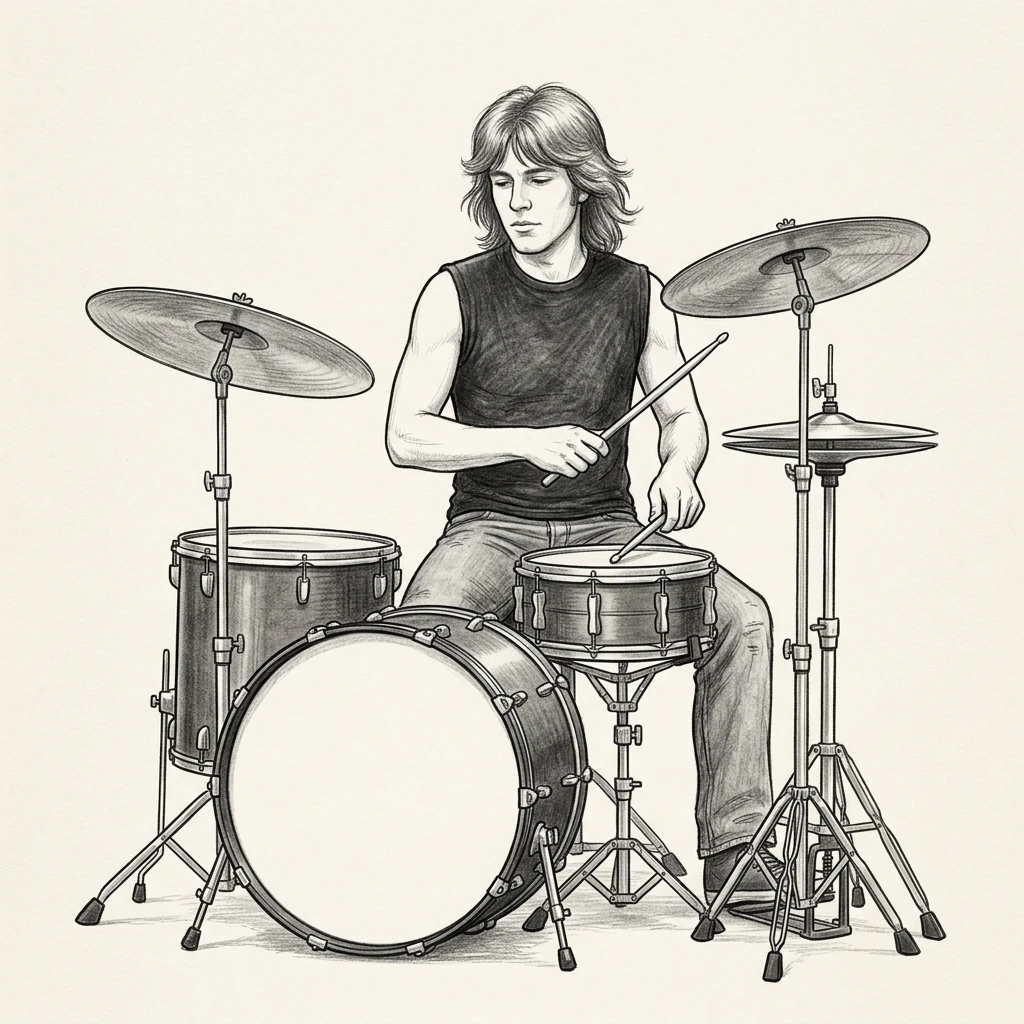
Phil Rudd is an Australian drummer best known as the long-time rhythm engine of hard rock icons AC/DC. Renowned for his unwavering internal clock, powerful backbeat, and uncompromising simplicity, Rudd defined the blueprint for hard rock pocket drumming. Rather than relying on fast fills or complex polyrhythms, his style centers on solid timekeeping, serving as the essential foundation for the band's massive guitar riffs. His playing on classic rock anthems has made him one of the most influential minimalist rock drummers in modern music history.
Drum It Original
Drum It Simplified
 Drum It Original
Drum It Simplified
 Drum It Original
Drum It Simplified
 Drum It Original
Drum It Simplified
 Drum It Original
Drum It Simplified
Drumming style
Phil Rudd’s drumming style is defined by economic precision, drive, and immense physical power. His primary role is establishing an unshakeable groove, often sitting comfortably right on or slightly behind the beat to create a relaxed yet heavy feel. He relies on straightforward 4/4 rock beats, anchoring the rhythm section alongside the bass and rhythm guitar. Rudd’s snare drum backbeat on beats two and four is famously consistent and heavy, frequently executed with clean rimshots. He avoids flashiness, keeping drum fills sparse, functional, and perfectly timed to mark song transitions. His hi-hat work remains steady and disciplined, providing a crisp, relentless pulse that propels the music forward without crowding the frequency spectrum.
Rudd hits the snare drum on beats two and four with extreme power and consistency, using sharp rimshots to cut clearly through heavy amplified guitars.
He places his notes with micro-timing precision, laying slightly back in the pocket to create a heavy, swinging rock feel against driving rhythm guitars.
Rudd avoids lengthy tom rolls, choosing simple crash hits or minimal two-stroke fills only when necessary to mark major structural transitions.
His continuous eighth-note hi-hat patterns feature tight dynamic control and even accenting, maintaining relentless momentum across long song sections.
Rudd plays clear, repetitive bass drum patterns focused on supporting the main guitar riff rather than introducing complex syncopation.
Practice room
Studying Rudd teaches how subtle placement relative to the click creates a heavy rock feel.
Practice: Practice playing a standard 4/4 groove along with a metronome at slow tempos (70–90 BPM), focusing on making every backbeat hit in the exact center of the pulse.
Learning his minimal approach demonstrates how leaving space makes song transitions more impactful.
Practice: Try playing a full verse and chorus of a song while using only a single crash cymbal strike to mark the chorus entrance.
Rudd demonstrates how to produce a consistent rimshot sound on every single snare hit.
Practice: Practice playing continuous quarter-note snare hits with rimshots, aiming for identical tone and volume on every stroke.
His playing shows how putting the composition first creates timeless drum parts. Analyze a guitar riff and write the simplest possible bass and snare pattern that locks directly into the riff's natural accents.
Iconic tracks
AC/DC
Features one of the most iconic, minimalist drum intros in rock history. Studying this track highlights how a straightforward 4/4 beat with perfectly timed snare accents can elevate a guitar riff into a worldwide anthem.
Drum this partAC/DC
Demonstrates immaculate pocket and drive, with a laid-back feel that pushes the chorus forward without rushing. Studying it helps drummers learn how to control tempo fluctuations and keep a groove steady.
Drum this partAC/DC
Shows how space and patient entry build tension. Rudd enters after the bell tolls and guitar intro, delivering a heavy, deliberate beat that grounds the track's ominous mood.
Drum this partAC/DC
Displays how a driving 4/4 groove provides a rock-solid bed capable of locking in alongside unusual instrumentation like bagpipes. Studying this song shows how steady hi-hat work holds a song together.
AC/DC
Highlights dynamic space and sudden stops. The drum part relies on precise rest placement and explosive backbeats, teaching drummers how silent pauses increase the impact of incoming hits.
The story
Born Phillip Hugh Norman Witschke Rudd in Melbourne, Australia, in 1954, Phil Rudd began playing drums as a teenager. He gained early professional experience with local Melbourne outfits, including Coloured Balls and Buster Brown, before auditioning for AC/DC in early 1975. Rudd quickly became an indispensable component of the band’s signature sound, laying down the grooves on legendary studio albums such as T.N.T. (1975), Let There Be Rock (1977), Highway to Hell (1979), and Back in Black (1980).
Rudd left AC/DC in 1983 amid personal stresses and creative friction, temporarily stepping away from high-profile touring. He rejoined the group in 1994, restoring their classic rhythm section for hit albums like Ballbreaker (1995), Stiff Upper Lip (2000), and Black Ice (2008). Despite personal challenges that kept him from touring during the mid-2010s, he returned to record AC/DC's 2020 album Power Up. Outside of AC/DC, he released a solo album, Head Job, in 2014. Rudd's legacy remains intrinsically tied to his status as the primary architect of AC/DC's timeless, hard-hitting beat.
Drummer Tube is an independent educational platform and is not affiliated with, endorsed by, or sponsored by Phil Rudd, AC/DC, Buster Brown or any related artists. All artist names, song titles and trademarks belong to their respective owners and are used for identification and educational purposes only.