

Money

Money
Drum Sheet Music

Practice Pink Floyd on Drums

Advanced

See How Drummer Tube Helps You Learn Songs Faster

Want access to all lessons?

View Plans >> Unlock this song – $7.90

Learn to Play Money Faster With Pro Interactive Drum Player

Play Sample Song For Free

Master This Song

$7.90

Original + Simplified

  • Download both versions as drum sheet PDFs
  • Play along with both versions in the interactive player for 2 months
Buy This Song

One-time payment · No subscription

Original
Simplified

Choose your Drum Sheet Version

Two versions of the drum sheet - choose the one that fits your level and goals.

ORIGINAL VERSION
Difficulty Level:
Advanced
  • Exactly as played on the original recording
  • All fills & ghost notes
  • Full arrangement
SIMPLIFIED VERSION
Difficulty Level:
Intermediate
  • Easier to learn
  • Simplified fills
  • Reduced ghost notes
  • Perfect for beginners & intermediates

Not sure which version?

We recommend starting with the Simplified Version and moving to the Original Version once you're comfortable with the groove and structure.

Unlock all songs library and practice like a pro:

$10 / month

Billed at $120 per year

  • 7-day free trial
  • Full access to all songs
  • Interactive player
  • Downloadable drum sheets
  • Full support
  • Cancel anytime
  • 30-day money-back guarantee

$15 / month

Billed at $15 per month

  • Full access to all songs
  • Interactive player
  • Downloadable drum sheets
  • Full support
  • Cancel anytime

Drumming Techniques You'll Learn in Money

  • Odd Time Signature Navigation
  • Time Signature Transition Smoothness
  • Swung Eighth Note Consistency
  • Internal Clock Pulse Precision
  • Asymmetrical Drum Fill Placement

Recommended For

This drum transcription is recommended for intermediate to advanced drummers aiming to master odd time signatures and complex metric modulations. It is highly beneficial for rock players seeking to develop a relaxed swing feel, improve rhythmic precision, and learn how to transition seamlessly between asymmetrical and symmetrical grooves with confidence.

Learn to play Money on drums

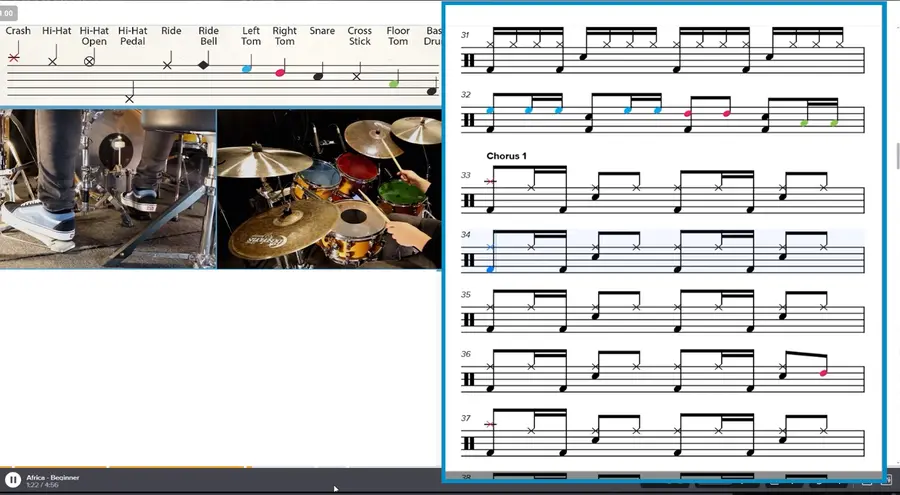
Play Money drum cover with our interactive drum sheet and advanced practice tools designed for progressive rock. Navigating Nick Mason's distinctive 7/4 time signature requires precision, and our synchronized drum notation helps you track each beat in real-time. Use tempo control to slow down the complex shifting rhythms, lock in the swung eighth-note groove, and utilize looping sections to master the transition into the 4/4 guitar solo. By utilizing the isolated drums feature, you can analyze every snare placement and snare dynamic. This comprehensive toolkit accelerates your ability to learn drums, navigate odd times, and improve your overall limb independence. Grab your sticks and start mastering this rhythmic masterpiece today!

Song information

Artist: Pink Floyd

Drummer: Nick Mason

Album: The Dark Side of the Moon

Released: 1973

Sheet Music Details

Length

4 pages of highly readable, clean drum score layouts.

Tempo

120-129

Time Signature

4/4

Key features

Features a detailed transcription of the signature 7/4 swung groove, clear notation for the 4/4 time signature transitions, and step-by-step layouts of Nick Mason's syncopated fills and solo phrasing.

Song's Overview

Released in 1973 on Pink Floyd's album The Dark Side of the Moon, this track stands out as a defining piece in progressive rock, famously proving that an odd time signature can captivate a mainstream audience. The song is anchored by an unusual 7/4 time signature, driven initially by a cash register sound loop that establishes a concrete loop for the band to follow. For drummers looking to learn Money on drums, the track presents an engaging study in rhythmic phrasing and time signature transitions. Drummer Nick Mason delivers a masterclass in restraint and groove, locking down a bluesy, swung eighth-note feel that prevents the 7/4 meter from sounding forced or awkward. One of the most critical elements of the drumming arrangement is the sudden shift to a standard 4/4 groove during the extended saxophone and guitar solos, before smoothly pivoting back to the original seven-beat frame. This structural shift requires excellent internal clock control and musical awareness.Studying a money drum sheet allows players to look closely at Mason’s clever fills, which often cross over bar lines to navigate the asymmetrical time signature. Ultimately, creating a Money drum cover challenges your ability to maintain a rock-solid pocket while executing odd-time phrasing seamlessly.

See How Drummer Tube Helps You Learn Songs Faster

Want access to all lessons?

View Plans >> Unlock this song – $7.90

About the Drummer

Nick Mason is the founding drummer and only continuous member of the legendary progressive rock band Pink Floyd. Renowned for his atmospheric, tasteful, and patient approach to drumming, Mason played a pivotal role in shaping the soundscapes of space rock and progressive rock. Rather than relying on hyper-technical speed, his playing emphasizes mood, orchestral tom fills, dynamic restraint, and serving the song. His understated groove provided the foundation for Pink Floyd’s extended compositions, making him one of rock history's most distinct musical storytellers behind the drum kit.

Drumming Style

Nick Mason’s drumming style is defined by spaciousness, deep groove, and expressive dynamic control. He excels at leaving room for texture and melody, often utilizing slow tempos and wide soundscapes to build emotional tension. A key characteristic of his playing is his distinct tom orchestration—using sweeping rototom or floor tom rolls that feel cinematic rather than acrobatic. Mason rarely overplays, choosing precise backbeats, understated hi-hat work, and subtle cymbal swells that support Pink Floyd’s dense guitar textures and synthesizer pads. His feel combines jazz-influenced fluidity from his early influences with steady, deliberate rock timing, making his drum parts instantly recognizable and deeply musical.

Practice Advice

01
Start Slow in Seven
The original track sits around 120 BPM. Begin your metronome practice at 90 BPM to internalize the asymmetrical 7/4 meter. Focus on counting the seven quarter-note beats clearly before attempting the full track speed to ensure your limbs place the backbeat cleanly.
02
Loop the Time-Signature Changes
Isolate the bars where the song shifts from 7/4 to 4/4 for the guitar solo, and back again. Use looping tools to repeat these specific transitions until your internal clock handles the expanding and contracting measures smoothly without rushing.
03
Mind the Swung Eighths
A frequent pitfall is playing the eighth notes straight. Nick Mason uses a distinct, relaxed swing feel throughout the main groove. Avoid rushing the late eighth notes, particularly on the hi-hat, to prevent the pocket from sounding stiff.
04
Lock into the Cash Loop
Keep your bass drum and snare perfectly aligned with the driving bassline and the implied cash register rhythm. Focus on keeping your quarter-note pulse unshakeable, treating the unusual meter with the same steady consistency you would bring to a standard blues rock pocket.
05
Navigate Fills Across Bar Lines
Mason’s fills often stretch across the 7/4 frame, which can easily disorient your timing. Practice these fills slowly, paying attention to where the downbeat lands in the following measure, ensuring you exit each phrase cleanly on beat one.

Learning Roadmap

Phase 1: Internalize the Basic 7/4 Groove

Isolate the primary verse rhythm. Practice playing a relaxed, swung eighth-note pattern on the hi-hat while matching your kick and snare drops to the famous seven-beat bassline. Master this loop slowly until counting to seven becomes second nature.

Phase 2: Transition Fluently Between Meters

Focus on the structural shifts into the 4/4 guitar solo and back into 7/4. Practice entering and exiting these sections cleanly, ensuring your brain and limbs instantly adjust to the changing length of each measure without losing the pulse.

Phase 3: Smooth Out Odd-Meter Drum Fills

Analyze the fills Nick Mason plays during the verses and the solo breakdown. Practice executing these phrases slowly, ensuring you accurately track the downbeat of the next measure, as fills in 7/4 can easily disrupt your timing.

Phase 4: Build Endurance and Full Arrangement Flow

Combine all individual parts to perform the complete song. Focus on maintaining a deep, relaxed pocket across the full six minutes, managing your dynamics during the softer saxophone phrases and elevating your energy during the intense guitar solo.

FAQ

What time signature is Money by Pink Floyd played in?

Money is primarily written in a 7/4 time signature for the intro, verse, and keyboard sections, but it switches to standard 4/4 time during the guitar solo before returning to 7/4.

What is the BPM of Money by Pink Floyd?

The original studio recording of Money plays at approximately 120 BPM throughout both the 7/4 verse sections and the 4/4 guitar solo.

Is Money by Pink Floyd difficult to play on drums?

It is considered intermediate to advanced. While the individual drum fills are straightforward, playing comfortably in 7/4 time and switching smoothly into 4/4 requires solid counting and timing discipline.

Who played drums on Money by Pink Floyd?

Nick Mason played drums on the original studio recording of Money on Pink Floyd's 1973 album The Dark Side of the Moon.

How do I count 7/4 time when learning Money on drums?

You can count seven straight quarter-note beats (1-2-3-4-5-6-7) per measure, or break it down into phrasing groups such as 4+3 (1-2-3-4, 1-2-3) to follow the main riff.

Related songs

Pro Practice Feature

Still figuring this song out on your own?

Learn this drum cover faster with our interactive player:

Used by +1,000 drummers worldwide

Registr to start your Week Free Trial