
Sunday Bloody Sunday

Sunday Bloody Sunday
Drum Sheet Music

Practice U2 on Drums

Intermediate to Advanced

See How Drummer Tube Helps You Learn Songs Faster

Want access to all lessons?

View Plans >> Unlock this song – $7.90

Learn to Play Sunday Bloody Sunday Faster With Pro Interactive Drum Player

Play Sample Song For Free

Master This Song

$7.90

Original + Simplified

  • Download both versions as drum sheet PDFs
  • Play along with both versions in the interactive player for 2 months
Buy This Song

One-time payment · No subscription

Original
Simplified

Choose your Drum Sheet Version

Two versions of the drum sheet - choose the one that fits your level and goals.

ORIGINAL VERSION
Difficulty Level:
Intermediate to Advanced
  • Exactly as played on the original recording
  • All fills & ghost notes
  • Full arrangement
SIMPLIFIED VERSION
Difficulty Level:
Easy to Intermediate
  • Easier to learn
  • Simplified fills
  • Reduced ghost notes
  • Perfect for beginners & intermediates

Not sure which version?

We recommend starting with the Simplified Version and moving to the Original Version once you're comfortable with the groove and structure.

Unlock all songs library and practice like a pro:

$10 / month

Billed at $120 per year

  • 7-day free trial
  • Full access to all songs
  • Interactive player
  • Downloadable drum sheets
  • Full support
  • Cancel anytime
  • 30-day money-back guarantee

$15 / month

Billed at $15 per month

  • Full access to all songs
  • Interactive player
  • Downloadable drum sheets
  • Full support
  • Cancel anytime

Drumming Techniques You'll Learn in Sunday Bloody Sunday

  • Military Cadence Precision
  • Hand-to-Hand Coordination
  • Dynamic Control Accentuation
  • Mid-Tempo Groove Consistency
  • Independence of Bass Drum

Recommended For

This drum sheet is recommended for intermediate drummers looking to improve military snare cadence precision and hand coordination. It is valuable for players who want to master dynamic separation between loud accents and quiet ghost notes while maintaining strict timing consistency across a driving, mid-tempo rock groove.

Learn to play Sunday Bloody Sunday on drums

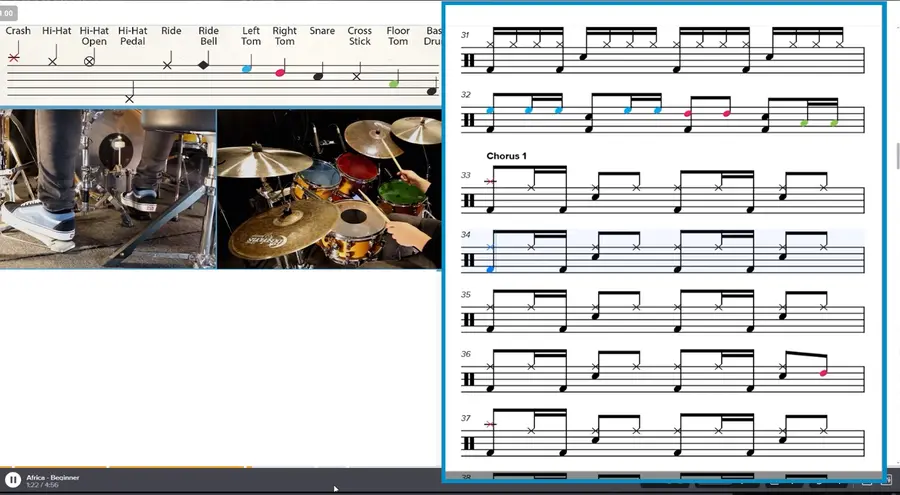
Play Sunday Bloody Sunday drum cover with our interactive drum sheet and synchronized video player. Follow every note in real time as the drum notation moves with the music, allowing you to master Larry Mullen Jr.’s distinct military-style snare cadence. Slow down the intricate opening pattern using tempo control, and loop difficult sections until your timing feels effortless. You can also isolate the drum track to hear exactly how the bass drum aligns with the snare groove. Developing your hand-to-hand coordination and strict dynamic control becomes faster and more effective than working with a standard printable drum sheet. Grab your sticks and start mastering this powerful drum score today!

Song information

Artist: U2

Drummer: Larry Mullen Jr.

Album: War

Released: 1983

Sheet Music Details

Length

3 pages of highly readable, clean drum score layouts.

Tempo

100-109

Time Signature

4/4

Key features

Features a distinct military snare cadence, syncopated tom-and-snare fills, precise hi-hat ostinatos, and four-on-the-floor bass drum patterns requiring exceptional hand-to-hand coordination, dynamic control, and mid-tempo endurance.

Song's Overview

Released in 1983 on U2's album War, Sunday Bloody Sunday altered the landscape of rock drumming by placing a marching band cadence at the forefront of a mainstream protest track. Instead of relying on a standard rock backbeat, the song centers on a highly driving, martial snare riff that instantly dictates the emotional weight and tension of the composition. For drummers, deciding to learn Sunday Bloody Sunday on drums means studying how to use the snare drum as a melodic and rhythmic hook. The drumming utilizes a continuous hand-to-hand pattern interspersed with sharp, syncopated accents and a steady undercurrent of sixteenth notes on the hi-hat. Larry Mullen Jr. intentionally avoided heavy crash cymbals to maintain a stark, unpolished atmosphere, proving how a tailored rhythmic choice can define a track's identity. When working through the Sunday Bloody Sunday drum sheet, you will notice how the groove shifts seamlessly into a driving four-on-the-floor feel during the chorus to lift the arrangement. Analyzing this Sunday Bloody Sunday drum cover reveals a masterclass in tension building and timing control, making it an essential study for anyone looking to expand their vocabulary beyond traditional rock patterns.

See How Drummer Tube Helps You Learn Songs Faster

Want access to all lessons?

View Plans >> Unlock this song – $7.90

About the Drummer

Larry Mullen Jr. is the co-founder and drummer of the legendary Irish rock band U2. Formed in Dublin in 1976 after Mullen posted a notice on his school bulletin board, U2 became one of the most successful acts in music history. Mullen's drumming is distinguished by its crisp, marching-band-inspired snare rhythms, metronomic stability, and unselfish musicality. Rather than relying on conventional rock fill tropes, his playing emphasizes tom-heavy grooves, electronic integration, and precise dynamic control, providing the powerful emotional foundation for U2's anthemic sound.

Drumming Style

Larry Mullen Jr.’s drumming style is defined by discipline, military precision, and rhythmic economy. Influenced by early marching band training, he frequently utilizes crisp snare roll patterns and sixteenth-note articulation to drive tracks forward without relying on traditional hi-hat or ride cymbal timekeeping. He often shifts the main groove to the floor tom and rack toms, creating a deep, resonant backdrop that allows space for atmospheric guitars and basslines. Mullen embraces hybrid drumming, seamlessly blending acoustic drum kits with electronic loops, click tracks, and percussion samples. His dynamic awareness and focus on song structure make every stroke count.

Practice Advice

01
Start at a Lower Tempo
The main military-style cadence requires precise articulation. Start practicing at 80 BPM rather than the full 103 BPM. Use tempo control to ensure your double strokes and single strokes are perfectly even before speeding up.
02
Loop the Opening Pattern
The intro sets the standard for the entire track. Isolate and loop these initial bars to build muscle memory for the continuous hand-to-hand movement between the snare and the hi-hat without losing speed.
03
Avoid Rushing the Fills
A common mistake is rushing the syncopated fills leading into the chorus. Maintain a steady internal metronome pulse, keeping your snare accents crisp and perfectly aligned without pushing the tempo forward.
04
Lock in the Chorus Pocket
Focus on your timing consistency when the groove shifts to the four-on-the-floor bass drum pattern. Keep the bass drum perfectly separated from the snappy snare accents to maintain a solid, driving pocket.
05
Master the Martial Snare Accent
The defining challenge of this song is dynamic control within the cadence. Keep your unaccented notes soft (ghost notes) while cracking the accented beats firmly, creating the essential marching tension.

Learning Roadmap

Phase 1: Develop the Marching Snare Cadence

Isolate the main verse rhythm. Focus on the alternating hand-to-hand pattern across the snare drum and hi-hat. Practice slowly to ensure every single and double stroke is clean, balanced, and perfectly timed.

Phase 2: Transition into Chorus Grooves

Analyze the shift from the military snare pattern to the driving four-on-the-floor feel. Practice entering and exiting the chorus smoothly, maintaining an unwavering pulse as the bass drum takes on a more prominent role.

Phase 3: Refine Syncopated Accents and Fills

Work through the energetic accents scattered throughout the track. Isolate the quick triplet fills and rhythmic stops, making sure you don't hesitate or drop the tempo when moving back into the main groove.

Phase 4: Build Endurance and Play Seamlessly

Combine all sections and play along with the entire song transcription. Focus on your physical stamina, ensuring your dynamic control and rhythmic precision remain sharp and authoritative from the opening beat to the end.

FAQ

What skill level is required to play Sunday Bloody Sunday on drums?

Sunday Bloody Sunday is ideal for intermediate drummers. While the patterns do not feature fast footwork, mastering the march-style snare rudiments and tight timing requires good wrist control and steady tempo.

What makes the drum beat in Sunday Bloody Sunday unique?

Instead of a standard rock backbeat on counts 2 and 4, the drum beat is built around a military marching snare pattern with accented sixteenth notes and open hi-hat accents.

What tempo is Sunday Bloody Sunday played at?

The song is recorded at approximately 103 BPM in a standard 4/4 time signature.

How can I improve my snare articulation for this song?

Practice the snare pattern slowly with a metronome, focusing on relaxed wrist motion, consistent stick height, and clear volume differences between accented and unaccented sixteenth notes.

Do I need a full drum kit to start learning this song?

You can start learning the main snare pattern on a practice pad to build wrist control and muscle memory before transferring the groove, hi-hat accents, and cymbal strikes to a full drum kit.

Related songs

Pro Practice Feature

Still figuring this song out on your own?

Learn this drum cover faster with our interactive player:

Used by +1,000 drummers worldwide

Registr to start your Week Free Trial