
 Drum It Original
About the drummer
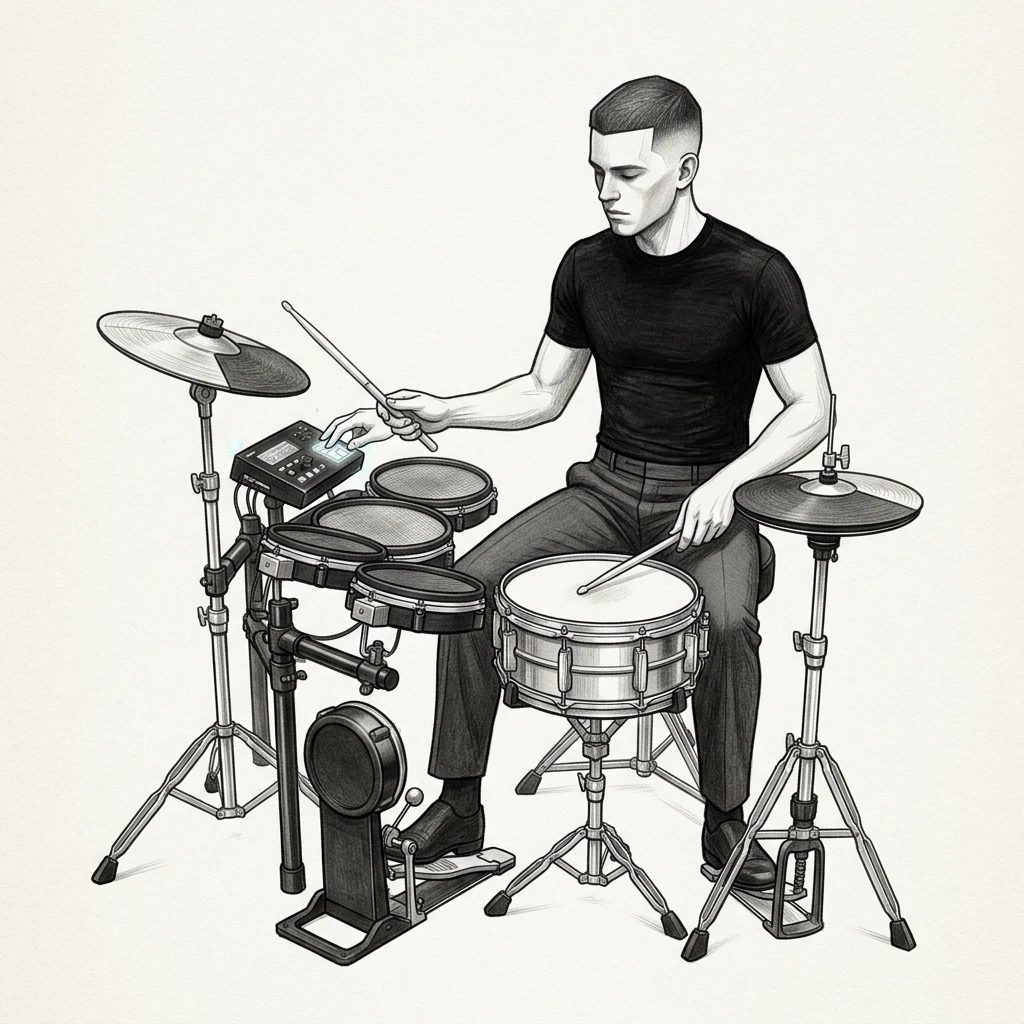
Drums Programming refers to the art of sequencing, creating, and producing drum parts electronically using hardware drum machines, samplers, and Digital Audio Workstations (DAWs). Rather than representing a single individual, drum programming encompasses the work of music producers and engineers who design rhythmic foundations across pop, electronic, rock, and hip-hop. Studying programmed drums offers drummers valuable insight into perfect grid alignment, sonic layering, micro-timing, and loop consistency, bridging the gap between digital music production and physical drum set performance.
Drum It Original
Drum It Simplified
 Drum It Original
Drum It Simplified
 Drum It Original
Drum It Simplified
 Drum It Original
Drum It Simplified
 Drum It Original
Drum It Simplified
 Drum It Original
Drum It Simplified
Drumming style
The style of drum programming centers on precision, consistency, and tailored sound design. Programmed beats range from hyper-quantized synth-pop rhythms to humanized grooves with subtle timing offsets and velocity variations. Unlike traditional acoustic drumming, programmed drums rely heavily on stacked samples—such as pairing an acoustic snare with an electronic clap or sub-kick—to achieve ideal balance in a mix. The approach prioritizes clarity, steady pulse, and repetition, creating an unyielding metric foundation. Fills are often concise and mathematically structured, serving song transitions while preserving the track's momentum. For acoustic drummers, understanding programmed styles enhances control over timing, dynamics, and groove economy.
Grid Quantization – Aligning rhythmic events strictly to fractional time divisions for absolute timing stability.
Sample Stacking – Layering multiple kick, snare, or percussion samples to build full-frequency drum sounds.
Micro-Timing Offsets – Intentionally shifting specific MIDI notes slightly off the grid to create swing, shuffle, or human feel.
Velocity Curve Control – Fine-tuning note volumes to emulate or purposefully idealize dynamic variations.
Rapid Subdivision Rolls – Using automated high-speed hi-hat or snare subdivisions to create tension and transitional movement.
Practice room
Programmed beats provide a absolute reference for timing.
Practice: Practice playing along with quantized loops to eliminate subtle rushing or dragging.
Electronic beats maintain consistent volume per stroke.
Practice: Practice executing repeated snare backbeats and kick strokes with consistent velocity.
Sequenced patterns focus on essential elements.
Practice: Practice paring down unnecessary fills to maintain a rock-solid pocket.
Studying programmed parts helps drummers adapt acoustic setups using dampening, stack cymbals, or auxiliary pads to recreate digital sound textures.
Iconic tracks
"Take On Me" by A-ha – Features a fast-paced, driving 1980s LinnDrum pattern. Studying this part helps drummers practice relentless 8th-note hi-hat drive and consistent kick-snare placement.
"Personal Jesus" by Depeche Mode – Built on a heavy, sampled stomp-and-clap shuffle groove. Studying this part teaches drummers how to control mid-tempo swing and heavy accent placement.
"I Want It That Way" by Backstreet Boys – Demonstrates classic late-90s pop sequencing with crisp snares and subtle syncopation. Studying it helps drummers master smooth pop pocket playing.
"Treasure" by Bruno Mars – Features a retro disco-funk programmed rhythm with snappy handclaps. Studying it teaches steady four-on-the-floor kick control and precise hi-hat openings.
"STAY" by The Kid LAROI & Justin Bieber – Uses an uptempo synth-pop electronic beat. Studying this part builds endurance and precision when playing fast, repetitive pop grooves.
The story
Drum programming emerged in the 1970s with early electronic rhythm units, gaining massive commercial momentum in the 1980s through legendary hardware like the LinnLM, LinnDrum, and Roland TR-808 and TR-909. Pioneers in synth-pop and new wave, such as A-ha and Depeche Mode, integrated programmed percussion to define the iconic electronic sounds of that era.
Throughout the 1990s, the development of digital samplers like the Akai MPC series transformed pop, hip-hop, and R&B production. Producers such as Max Martin utilized precise MIDI sequencing to forge polished, radio-dominant pop tracks for artists like the Backstreet Boys. Into the 2000s and beyond, software DAWs allowed producers to blend digital precision with organic drum samples, enabling hybrid grooves seen in contemporary tracks by Bruno Mars and The Kid LAROI.
Today, drum programming remains an essential pillar of modern record-making. It influences how modern acoustic drummers approach studio work, click track precision, and live song recreation.
Drummer Tube is an independent educational platform and is not affiliated with, endorsed by, or sponsored by Drums Programming, A-ha, Depeche Mode or any related artists. All artist names, song titles and trademarks belong to their respective owners and are used for identification and educational purposes only.