
Treasure

Treasure
Drum Sheet Music

Practice Bruno Mars on Drums

Easy to Intermediate

See How Drummer Tube Helps You Learn Songs Faster

Want access to all lessons?

View Plans >> Unlock this song – $7.90

Learn to Play Treasure Faster With Pro Interactive Drum Player

Play Sample Song For Free

Master This Song

$7.90

Original + Simplified

  • Download both versions as drum sheet PDFs
  • Play along with both versions in the interactive player for 2 months
Buy This Song

One-time payment · No subscription

Original
Simplified

Choose your Drum Sheet Version

Two versions of the drum sheet - choose the one that fits your level and goals.

ORIGINAL VERSION
Difficulty Level:
Easy to Intermediate
  • Exactly as played on the original recording
  • All fills & ghost notes
  • Full arrangement
SIMPLIFIED VERSION
Difficulty Level:
Easy
  • Easier to learn
  • Simplified fills
  • Reduced ghost notes
  • Perfect for beginners & intermediates

Not sure which version?

We recommend starting with the Simplified Version and moving to the Original Version once you're comfortable with the groove and structure.

Unlock all songs library and practice like a pro:

$10 / month

Billed at $120 per year

  • 7-day free trial
  • Full access to all songs
  • Interactive player
  • Downloadable drum sheets
  • Full support
  • Cancel anytime
  • 30-day money-back guarantee

$15 / month

Billed at $15 per month

  • Full access to all songs
  • Interactive player
  • Downloadable drum sheets
  • Full support
  • Cancel anytime

Drumming Techniques You'll Learn in Treasure

  • Four-on-the-Floor Groove Consistency
  • Precise Off-Beat Hi-Hat Articulation
  • Upbeat Disco Funk Wrist Stamina
  • Clean Sectional Fill Transition Timing
  • Hand-to-Foot Coordination Precision

Recommended For

This drum score is recommended for intermediate drummers looking to improve pocket stability, dynamic cymbal control, and upbeat funk endurance. It is highly valuable for players wanting to master clean dance patterns, helping them develop fluid transitions, consistent backbeat dynamics, and excellent high speed timing precision across the arrangement.

Learn to play Treasure on drums

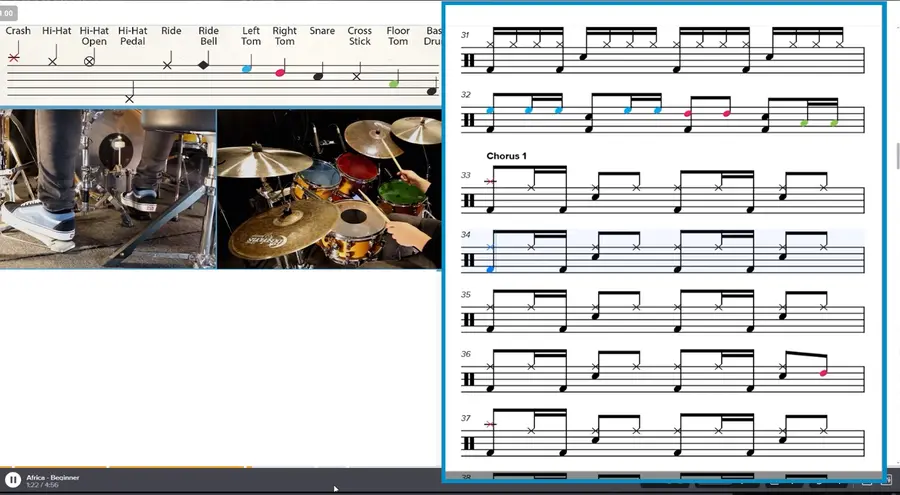
Play Treasure drum cover with our interactive drum sheet and synchronized video player. Follow every punchy disco-funk accent in real time as the synchronized drum notation moves seamlessly along with the music. Slow down the rapid off-beat hi-hat openings using tempo control, select custom looping sections to lock down the transition into the energetic chorus, and activate isolated drums to hear the crisp definition of every snare backbeat. Mastering this groove is an excellent way to improve your four-on-the-floor stability and precise sixteenth-note limb independence. Our dynamic learning tools make studying this arrangement faster, simpler, and far more comprehensive than a standard printable drum sheet. Grab your sticks, lock into the pocket, and start practicing today!

Song information

Artist: Bruno Mars

Album: northodox Jukebox

Released: 2012

Sheet Music Details

Length

2 pages of highly readable, clean drum score layouts.

Tempo

110-119

Time Signature

4/4

Key features

This complete drum transcription features clear drum tabs for tracking an unwavering four-on-the-floor bass drum pulse, crisp off-beat hi-hat openings, and rapid single-stroke fills. It challenges your upbeat wrist endurance, micro-timing accuracy, and staccato funk dynamic control.

Song's Overview

Released in 2012 on Bruno Mars's album Unorthodox Jukebox, "Treasure" revitalized retro 1970s disco-funk and 1980s synth-pop elements for modern audiences. The track serves as a masterful tribute to the dance rhythms of Earth, Wind & Fire and Michael Jackson, utilizing a tight, punchy arrangement driven by a relentless bassline. For musicians who want to learn Treasure on drums, the track is a masterclass in dynamic restraint and electronic-infused four-on-the-floor consistency. The core of this Treasure drum cover relies on an unyielding quarter-note kick drum pulse and a crisp snare backbeat that locks perfectly with the syncopated slap bass. While the baseline pattern seems simple, the intricate, crisp off-beat hi-hat openings and quick sixteenth-note fills require precise wrist articulation and excellent metric precision. Reviewing an accurate treasure drum sheet shows how the drumming serves as the ultimate rhythmic anchor, prioritizing a steady, danceable pocket over complex phrasing or heavy syncopation. Analyzing this performance teaches drummers how subtle micro-timing adjustments and consistent velocity on the snare drum can completely elevate a pop track, making this drum sheet an essential study for mastering upbeat, high-energy dance grooves.

See How Drummer Tube Helps You Learn Songs Faster

Want access to all lessons?

View Plans >> Unlock this song – $7.90

About the Drummer

Drums Programming refers to the art of sequencing, creating, and producing drum parts electronically using hardware drum machines, samplers, and Digital Audio Workstations (DAWs). Rather than representing a single individual, drum programming encompasses the work of music producers and engineers who design rhythmic foundations across pop, electronic, rock, and hip-hop. Studying programmed drums offers drummers valuable insight into perfect grid alignment, sonic layering, micro-timing, and loop consistency, bridging the gap between digital music production and physical drum set performance.

Drumming Style

The style of drum programming centers on precision, consistency, and tailored sound design. Programmed beats range from hyper-quantized synth-pop rhythms to humanized grooves with subtle timing offsets and velocity variations. Unlike traditional acoustic drumming, programmed drums rely heavily on stacked samples—such as pairing an acoustic snare with an electronic clap or sub-kick—to achieve ideal balance in a mix. The approach prioritizes clarity, steady pulse, and repetition, creating an unyielding metric foundation. Fills are often concise and mathematically structured, serving song transitions while preserving the track's momentum. For acoustic drummers, understanding programmed styles enhances control over timing, dynamics, and groove economy.

Practice Advice

01
Start Below Full Tempo
The song's upbeat disco pulse sits at 116 BPM. Use tempo control to drop the speed to 90 BPM initially. Focus on locking your bass drum squarely with the click to establish a rigid foundation before adding fast fills.
02
Loop the Verse Transitions
The subtle shifts from the tight, closed verse patterns into the wide-open chorus grooves require smooth hand coordination. Isolate and loop these specific sections to build the muscle memory needed to execute the transitions cleanly without rushing.
03
Avoid Rushing the Backbeat
A frequent mistake when playing this upbeat funk track is leaning ahead of the beat on the snare drum. Keep your arm movements relaxed and let the sticks fall naturally on beats two and four to maintain a deep pocket.
04
Strengthen Your Internal Pulse
Practice the continuous four-on-the-floor kick pattern with a metronome. Ensure every single quarter-note strike hits with identical dynamic weight, providing a reliable low-end clock that matches the programmed precision of the studio track.
05
Master Crisp Hi-Hat Articulation
The defining element of this arrangement is the quick, syncopated off-beat hi-hat openings. Work on your ankle control to ensure the cymbals choke instantly on the following downbeat, avoiding a loose, muddy slosh that destroys the staccato funk feel.

Learning Roadmap

Phase 1: Secure the Four-on-the-Floor Foundation

Isolate the primary disco-funk rhythm by locking your right foot into a steady quarter-note pattern. Pair this with a clean snare backbeat at a reduced tempo to establish fundamental hand-to-foot coordination before tackling subdivisions.

Phase 2: Integrate Syncopated Hi-Hat Openings

Add the brisk eighth-note hand pattern and incorporate the quick off-beat hi-hat lifts. Use this digital drum lesson to ensure the pedal releases do not disturb your steady bass drum alignment or push the tempo forward.

Phase 3: Execute Precise Sixteenth-Note Fills

Analyze the short, explosive single-stroke rolls scattered throughout the arrangement transitions. Use looping features to practice entering and exiting these fills cleanly, focusing on landing heavily on the crash cymbal right on the downbeat.

Phase 4: Maintain Full Performance Pocket Endurance

Combine all distinct sections and perform along with the full song. Focus on managing your forearm relaxation and breathing patterns, ensuring your groove remains locked and authoritative from the opening synth hook to the final fade-out.

FAQ

What is the skill level required to play Treasure on drums?

Treasure is best suited for intermediate drummers. While the basic pattern is accessible, maintaining consistent four-on-the-floor kick balance and tight hi-hat dynamics requires good limb independence.

What is the main drumming technique used in Treasure?

The primary technique is maintaining a steady four-on-the-floor bass drum beat while executing syncopated sixteenth-note accents and off-beat openings on the hi-hat.

What is the tempo of Treasure by Bruno Mars?

The song is recorded at a steady tempo of 116 BPM.

Is Treasure played on acoustic drums or programmed?

The original studio track combines programmed retro drum samples with live drum performances recorded by Bruno Mars and Ari Levine to achieve an authentic 70s disco-funk feel.

Why use an interactive drum sheet to learn Treasure?

An interactive sheet allows you to loop complex hi-hat patterns and slow down tempo, making it easier to master subtle funk accents that are easy to miss on a static PDF score.

Related songs

Pro Practice Feature

Still figuring this song out on your own?

Learn this drum cover faster with our interactive player:

Used by +1,000 drummers worldwide

Registr to start your Week Free Trial