Master the Kit: The Ultimate Guide to Improving Your Drum Sight-Reading
In the world of drumming, there is a distinct line between a musician who plays by ear and a "pro" who can walk into any session, look at a piece of paper, and nail the performance on the first take. This skill is called Sight-Reading.
For many drummers, the sight of a complex chart filled with syncopated sixteenth notes and unfamiliar notations is enough to induce a cold sweat. However, sight-reading is not a "natural talent"—it is a mechanical and cognitive skill that can be developed with the right systems.
If you are looking to download free drum sheets and actually use them effectively, this guide will provide you with the essential tips to sharpen your sight-reading abilities.
1. Understand the "Language" of the Staff
Before you can read fluently, you must be "literate." Drum notation is logical, but it requires instant recognition. You shouldn’t have to think, "Is the note on the second space a snare or a tom?"
-
Standardization: While drum notation can vary slightly between publishers, most follow the PAS (Percussive Arts Society) standards. Ensure you know the difference between a standard note head (drums) and an 'X' note head (cymbals).
-
The Legend: Always check the drum legend at the beginning of a new book or chart. Knowing where the ride cymbal bell is versus the edge can save you from a "wrong note" in the middle of a groove.
2. Scan Before You Play: The 30-Second Rule
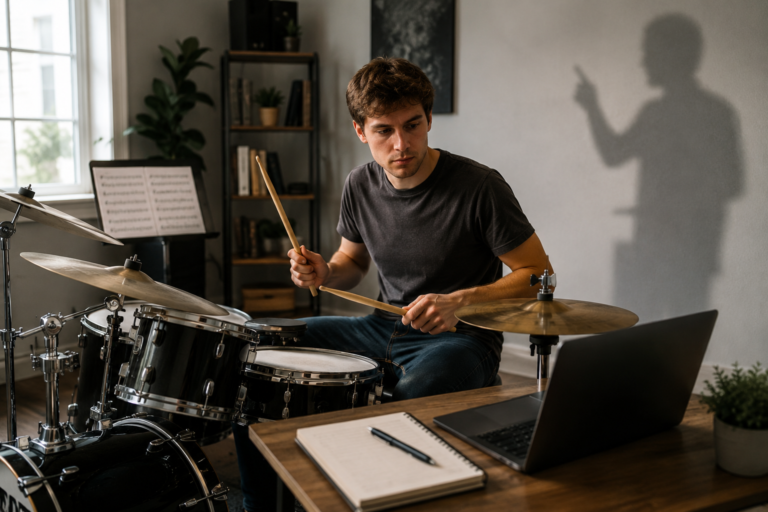
The biggest mistake drummers make is putting the sticks to the pads the moment they see the paper. Professional session players always spend at least 30 seconds scanning the chart before the count-in.
What to look for during your scan:
-
Time Signature: Is it $4/4$, $6/8$, or a tricky $7/8$?
-
Tempo and Feel: Is it a "Half-Time Shuffle" or a "Straight-Ahead Rock"?
-
Roadmaps: Look for repeats, D.S. al Coda, D.C. al Fine, and endings. Nothing kills a performance faster than missing a repeat and playing while everyone else has stopped.
-
The "Landmines": Scan for complex fills or sudden dynamic changes ($pp$ to $ff$). Mentally rehearse the stickings for these sections before you start.
3. Keep Your Eyes Ahead (The "Buffer" Technique)
If your eyes are looking at the note you are currently playing, you are already behind.
Think of reading drum music like reading a sentence in a book. Your eyes move ahead of your voice. In music, this is called Eye-Hand Span. Try to keep your eyes one to two beats (or even a full measure) ahead of your hands. This allows your brain to "buffer" the upcoming information, giving your limbs time to prepare for the next movement.
Pro Tip: Try covering a measure with a piece of paper the moment you start playing it. This forces your eyes to jump to the next measure while your brain finishes the current one.
4. Rhythm Over Nuance
When sight-reading, the most important thing is the rhythmic pulse. If you miss a ghost note on the snare or a crash on an accent, the song will survive. But if you lose the "One" ($1$), the entire band will fall apart.
-
Prioritize the Bass Drum and Snare: These are the "bones" of the beat. If the chart gets too busy, simplify the hi-hat pattern but keep the kick and snare locked in.
-
Don't Stop: If you make a mistake, do not stop playing. Jump back in on the next downbeat. In a professional setting, the ability to recover is more valuable than the ability to be perfect.
5. Subdivide Mentally
The secret to reading complex rhythms—especially syncopation—is constant mental subdivision. Even if the song is a slow ballad, your brain should be ticking like a metronome in eighth or sixteenth notes.
-
If you are playing a $4/4$ rock beat, count $1-e-\&-a, 2-e-\&-a...$ in your head.
-
When a rest appears, the subdivision acts as a bridge that carries you to the next note, ensuring you don't "rush" the silence.
6. Build a Library of "Rhythmic Words"
Experienced readers don't see individual notes; they see "rhythmic groupings."
Just as you don't read the letters D-O-G individually but see the word "DOG" as a single unit, you should recognize a "dotted eighth note followed by a sixteenth" as one rhythmic shape.
-
Spend time practicing common 1-measure subdivisions.
-
The more "rhythmic words" you have in your mental dictionary, the less brain power you spend decoding the page.
7. Use a Metronome (The Honest Teacher)
Practicing sight-reading without a metronome is a recipe for disaster. Without a click, you will naturally slow down during difficult sections and speed up during easy ones.
-
Start Slow: Find a chart on our site, set your metronome to 60 BPM, and play it perfectly.
-
The "One-Click" Method: Once you are comfortable, set the metronome to only click on the "1". This forces you to maintain the internal tempo while reading.
8. Diversify Your Reading Material
If you only read Rock charts, you will struggle the moment you see a Jazz "Lead Sheet" or a Funk "Linear Groove."
To become a master sight-reader, you must expose yourself to different genres. Each genre has its own shorthand:
-
Jazz: Often written as a "lead sheet" where you have to interpret the time based on rhythmic hits (comping).
-
Musical Theater: Famous for frequent time signature and tempo changes.
-
Orchestral Percussion: Focuses heavily on dynamics and specific mallet/stick choices.
Summary Checklist for Your Next Practice Session:
-
Select a random sheet (Check out our free PDF library!).
-
Identify the Time Signature and Tempo.
-
Scan for repeats and codas.
-
Count out the most difficult rhythm using your voice first.
-
Set the metronome and play through without stopping, no matter what.
Conclusion
Improving your sight-reading is the fastest way to "level up" your drumming career. It opens the door to studio work, pit orchestras, and last-minute session gigs. By combining the high-quality free drum sheets available on this site with the techniques mentioned above, you’ll find yourself playing more accurately, more confidently, and more musically.
Ready to put these tips to the test? Browse our collection of free drum notation and start your practice session today!