How to Practice Drums Without a Drum Teacher
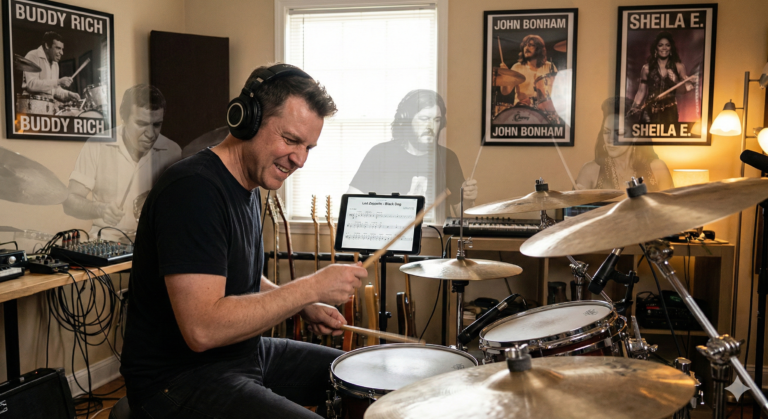
Learning the drums without a teacher may seem challenging at first, but thousands of drummers around the world have successfully developed their skills through self-study. With the right approach, modern learning tools, and a structured practice routine, it is entirely possible to become a confident and capable drummer on your own.
In fact, many drummers today have access to resources that previous generations could only dream of. Interactive drum sheet music, video lessons, slow-motion playback, drumless tracks, metronomes, and online practice platforms make independent learning more effective than ever before.
The key is not simply practicing more—it is practicing smarter.
In this guide, you'll learn how to structure your practice sessions, avoid common mistakes, and make steady progress even without a private drum instructor.
Can You Really Learn Drums Without a Teacher?
The short answer is yes.
A drum teacher can certainly accelerate your progress by correcting mistakes and providing personalized feedback. However, many successful drummers have developed much of their playing through self-directed practice.
What separates successful self-taught drummers from frustrated beginners is having:
- A clear practice plan
- Consistent practice habits
- Access to quality learning resources
- The ability to evaluate their own progress
Without these elements, it's easy to spend hours behind the drum kit without actually improving.
Set Clear Goals
Before you sit behind the drums, ask yourself:
"What am I trying to achieve?"
Many beginners practice randomly. One day they play fills, the next day they watch videos, and the day after they attempt a difficult song far beyond their current level.
A better approach is to create specific goals.
Examples include:
- Learn three beginner songs this month
- Improve timing with a metronome
- Master basic rock beats
- Learn to read drum sheet music
- Build foot coordination
Having clear goals gives your practice sessions direction and helps you measure progress.
Create a Practice Routine
One of the biggest advantages of having a drum teacher is accountability. Without a teacher, you must create your own structure.
A simple 45-minute practice session might look like this:
10 Minutes – Warm-Up
Start with basic exercises:
- Single strokes
- Double strokes
- Paradiddles
- Simple coordination exercises
The goal is to loosen up your hands and prepare your mind for focused practice.
15 Minutes – Technique Development
Focus on one specific skill:
- Bass drum control
- Hi-hat consistency
- Dynamics
- Rudiments
- Coordination
Avoid trying to improve everything at once.
15 Minutes – Song Practice
This is where the real learning happens.
Playing complete songs teaches:
- Timing
- Endurance
- Musicality
- Groove
- Song structure
Choose songs that are slightly challenging but still achievable.
5 Minutes – Review
Spend a few minutes reviewing what worked and what didn't.
Ask yourself:
- Which section felt difficult?
- What improved today?
- What should I focus on tomorrow?
This simple habit accelerates learning dramatically.
Learn Songs Instead of Random Beats
Many beginner drummers spend months practicing isolated drum beats but never learn complete songs.
Songs provide context.
They teach you:
- How grooves connect
- When fills should be used
- How drummers support a band
- How dynamics change throughout a performance
Even simple songs can teach valuable lessons.
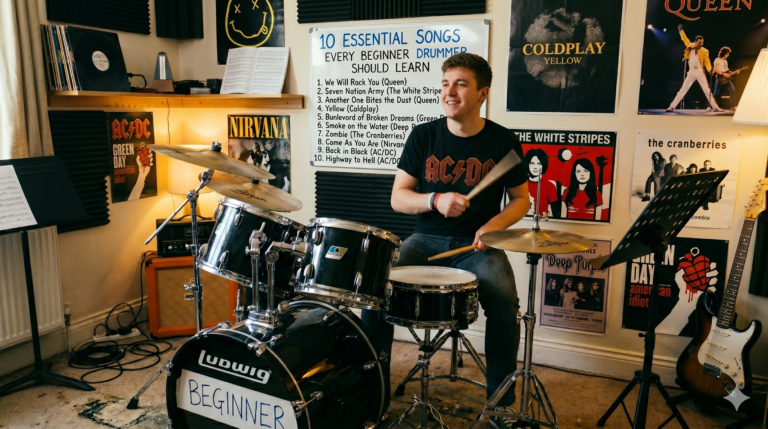
Some excellent beginner-friendly songs include:
- Seven Nation Army
- Boulevard of Broken Dreams
- Yellow
- Zombie
- Back in Black
Learning complete songs also keeps practice enjoyable and motivating.
Practice With a Metronome
If there is one tool every self-taught drummer should use, it is the metronome.
The metronome helps develop your internal clock and prevents the common habit of speeding up or slowing down without realizing it.
Start by practicing:
- Basic rock beats
- Rudiments
- Fills
- Song sections
At slow tempos.
Remember:
Playing perfectly at 70 BPM is far more valuable than struggling at 120 BPM.
As your consistency improves, gradually increase the tempo.
Record Yourself Regularly
Recording yourself is one of the closest substitutes for having a teacher.
When you're playing, it's difficult to notice mistakes in real time.
When you watch or listen to a recording, problems become obvious:
- Rushing
- Dragging
- Inconsistent dynamics
- Weak transitions
- Timing issues
Even professional drummers regularly record themselves to evaluate their performance.
A smartphone recording is often all you need.
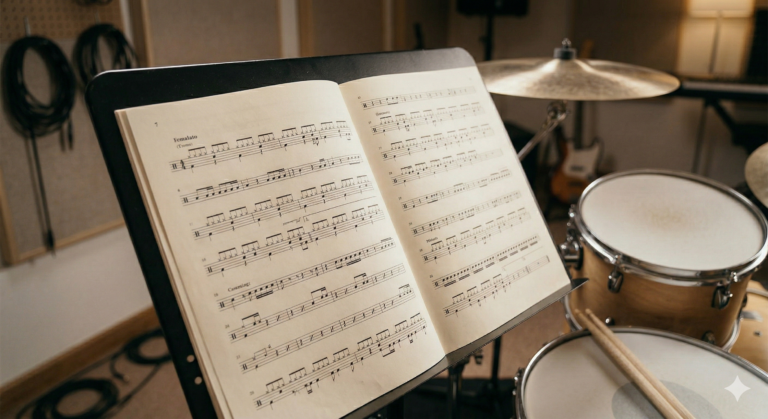
Learn to Read Drum Sheet Music
Many self-taught drummers avoid learning drum notation because it seems intimidating.
This is a mistake.
Reading drum sheet music can dramatically speed up your progress because it allows you to understand exactly what is being played.
Benefits include:
- Faster song learning
- Better timing
- Improved accuracy
- Access to thousands of songs and exercises
You don't need to become a professional sight-reader. Even a basic understanding of drum notation can make practice much more efficient.
Use Slow Practice
One of the biggest mistakes self-taught drummers make is practicing too fast.
Speed should never come before accuracy.
When learning a new groove or fill:
- Play it slowly.
- Play it correctly.
- Repeat it consistently.
- Increase the tempo gradually.
This approach builds muscle memory much faster than repeatedly making mistakes at full speed.
Many professional drummers spend more time practicing slowly than beginners realize.
Play Along With Drumless Tracks
Drumless tracks are one of the most powerful learning tools available today.
They allow you to experience what it's like to play with a real band while forcing you to maintain your own timing.
Benefits include:
- Better groove
- Improved timing
- Increased confidence
- More enjoyable practice sessions
Playing with a backing track feels much closer to performing live than practicing alone.
Focus on Consistency, Not Complexity
Many beginners become obsessed with impressive fills.
However, experienced drummers know that groove is far more important.
A drummer who can play a simple beat consistently is far more valuable than a drummer who plays complicated fills but struggles to keep time.
When practicing, ask yourself:
"Does this feel good?"
Rather than:
"Does this sound impressive?"
Great drumming is about serving the music.
Track Your Progress
Without a teacher, it can sometimes feel like you're not improving.
This is why tracking progress is important.
Keep a simple practice journal.
Record:
- What you practiced
- Songs learned
- Tempos achieved
- Skills that need work
After a few months, you'll be surprised by how much you've improved.
Small improvements accumulate into significant progress over time.
Avoid Information Overload
The internet contains an endless supply of drum lessons.
While this is a wonderful resource, it can also become a distraction.
Many drummers spend more time watching lessons than actually practicing.
Choose one learning path and follow it consistently.
Remember:
Watching a drum lesson is not the same as practicing drums.
Real improvement happens behind the kit.
Build a Long-Term Mindset
Learning drums is not a race.
Every drummer develops at a different pace.
Some skills may take days to learn.
Others may take months.
The most successful drummers are not necessarily the most talented—they are the most consistent.
Practicing 30 minutes every day will produce far better results than practicing four hours once a week.
Consistency beats intensity.
Final Thoughts
Learning drums without a teacher is completely achievable if you approach it with discipline and structure.
Focus on building strong fundamentals, learning complete songs, practicing with a metronome, recording yourself, and tracking your progress. Take advantage of modern tools such as drum sheet music, slow-motion playback, and drumless backing tracks to create a learning environment that supports steady improvement.
Most importantly, be patient with yourself.
Every great drummer started as a beginner who struggled with timing, coordination, and technique. What separates successful drummers from those who quit is simple: they kept showing up and practicing.
With the right mindset and consistent effort, you can make remarkable progress—even without ever stepping into a drum lesson.