Beyond Mimicry: Why Learning Drum Covers is the Ultimate Catalyst for Mastery
For decades, a debate has simmered in practice rooms and music conservatories: Is it better to be a "technical" drummer who masters every rudiment in the book, or a "musical" drummer who plays by ear? The truth, as any seasoned session pro will tell you, lies in the middle. However, there is one specific practice method that bridges this gap more effectively than any other: The Drum Cover.
While some might see recording a drum cover for YouTube or Instagram as an act of vanity, the process of learning a song note-for-note is actually a rigorous form of "reverse-engineering" that develops skills a metronome simply cannot touch.
1. Expanding Your Musical Vocabulary (The "Lego" Theory)
Imagine trying to write a novel if you only knew 50 words. You might be able to communicate basic needs, but you’ll never capture the nuances of human emotion. Drumming is no different.
When you learn a drum cover, you are essentially stealing "vocabulary" from the greats. Whether it’s John Bonham’s heavy-handed triplets, Steve Gadd’s linear paradiddle grooves, or Benny Greb’s rhythmic displacements, you are adding "bricks" to your creative library.
-
The Benefit: You stop thinking in terms of "Right-Left-Right-Left" and start thinking in "Phrases."
-
Real-World Application: When you’re later asked to improvise a fill in a rehearsal, your brain won't panic. It will instinctively reach for that "Cool Phil Collins fill" you mastered three months ago, adapting it to the new context.
2. The "Human" Metronome: Developing Real-World Timing
Practicing with a metronome is essential—don't stop doing it. But a metronome is a sterile, mathematical environment. Real music "breathes."
When you play along to a professional recording, you are learning to lock in with a "human" feel. You’ll notice that some drummers play "behind the beat" (like Questlove) to create a lazy, soulful pocket, while others play "on top of the beat" (like Stewart Copeland) to create urgency and energy.
Pro Tip: Learning covers teaches you "Micro-Timing." It’s the ability to know exactly where the "one" is, even when the groove feels like it's dragging or rushing intentionally.
3. Musicality and the Art of "The Laying Back"
The biggest mistake amateur drummers make is playing too much. They treat every song like a drum solo. Learning covers forces you to confront the reality of Song Structure.
By playing through a 4-minute pop track, you learn:
-
Dynamic Mapping: How the volume drops in the verse and explodes in the chorus.
-
Restraint: Sometimes the best thing you can do for a song is play a simple 4/4 kick-snare pattern for three minutes straight.
-
Transitions: How to use a subtle cymbal swell or a single ghost note to "announce" the next section of the song.
4. Technical Application in Context
You can practice the "Moeller Technique" or "Heel-Toe" doubles on a practice pad for hours. But until you try to execute those doubles while transitioning from a ride cymbal to a floor tom during a fast chorus, you haven't truly mastered them.
Drum covers act as a stress test for your technique. It’s one thing to do a double-stroke roll at 140 BPM in your bedroom; it’s another thing to do it while keeping your left foot steady on the hi-hat and maintaining the energy required for a Rock anthem.
5. Ear Training and Active Listening
To learn a song perfectly, you have to listen to it 100 times. You start to hear things you never noticed before:
-
The subtle ghost notes on the snare.
-
The way the drummer opens the hi-hat just a crack on the "and" of beat four.
-
The interaction between the kick drum and the bass guitar.
This develops your Active Listening skills. In a band setting, this is your most valuable asset. A drummer who can hear what the guitar player is doing and complement it is worth ten drummers who can play 32nd-note fills but don't listen to the melody.
6. The "Recording" Pressure: Accountability
If you decide to record your drum cover (even if you never post it), the stakes change. The camera and the microphone are the most honest teachers you will ever have.
When you record yourself, you will notice:
-
"Wait, my timing is actually shaky during that fill."
-
"My posture looks stiff, which is why my rolls sound choked."
-
"I'm hitting the crashes way too hard compared to the snare."
This feedback loop is the fastest way to improve. It forces a level of perfectionism that "just jamming" never will.
7. Endurance and Mental Focus
Playing a full song from start to finish without a single mistake is a mental marathon. If you lose focus for half a second in the bridge, the whole thing falls apart.
Learning complex covers (think Rush, Dream Theater, or Tool) builds Rhythmic Stamina. It trains your brain to stay "in the zone" for extended periods. This focus translates directly to live performances, where distractions—bright lights, screaming fans, or technical glitches—are everywhere.
8. Genre Fluidity: Breaking Out of Your Comfort Zone
Most drummers have a "home" genre. If you’re a Rock drummer, you probably play a lot of 2 and 4 backbeats. If you challenge yourself to cover a Bossa Nova track or a Funk tune by The Meters, you are forced to use your limbs in ways they aren't used to.
-
Independence: Latin tracks will build your foot independence.
-
Ghost Notes: Funk will build your snare hand sensitivity.
-
Power: Metal will build your double-kick speed and endurance.
By the time you go back to playing Rock, you’ll find that your playing has more "flavor" and "depth" because of the diverse genres you’ve explored.
Comparison: Practice Pad vs. Drum Covers
| Feature | Practice Pad / Rudiments | Drum Covers |
| Focus | Raw Mechanics & Speed | Application & Musicality |
| Timing | Absolute (Grid-based) | Relative (Feel-based) |
| Creativity | Limited (Technical) | High (Contextual) |
| Engagement | Low (Can be boring) | High (Rewarding/Fun) |
9. Finding Your Own Voice (The Paradox)
It sounds counterintuitive, but you find your original "voice" by imitating others. Every legendary drummer is a "mutt" of their influences.
-
Dave Grohl took the power of John Bonham and mixed it with the energy of DC Hardcore.
-
Travis Barker took marching band rudiments and applied them to Pop-Punk.
By learning covers, you aren't becoming a "clone." You are collecting tools. Eventually, you will start mixing a Stewart Copeland hi-hat pattern with a Chad Smith kick drum groove, and suddenly—that's your sound.
10. How to Approach a Cover for Maximum Growth
To get the 1400-word level of benefit, don't just "wing it." Follow this 3-step process:
Step 1: The "Skeleton" (Transcribing)
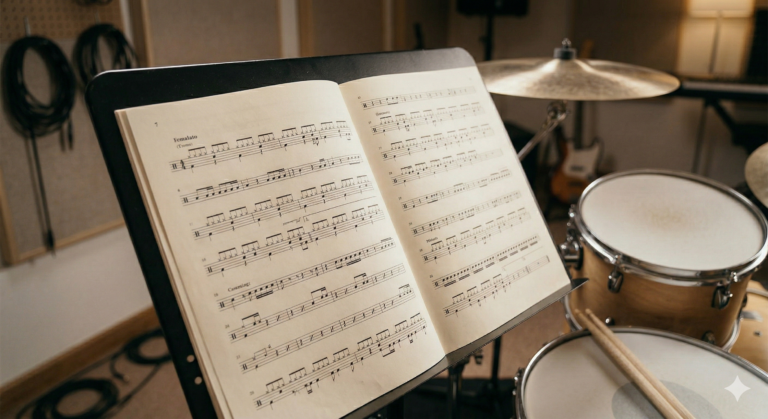
Listen to the song and chart it out. You don't need formal notation, but you do need a map. Intro (8 bars) -> Verse (16 bars) -> Chorus (8 bars)... Knowing the structure reduces the mental load so you can focus on the physical execution.
Step 2: The "Slow-Burn" (Deconstruction)
Use software (like Moises.ai or even YouTube settings) to slow the song down to 75%. If you can't play it perfectly at 75%, you have no business trying it at 100%. Master the tricky fills at a slow tempo first.
Step 3: The "Isolated" Test
Try playing the drum parts without the music (just a click). If the part still sounds "musical" and "recognizable" even without the guitars and vocals, you’ve truly mastered the soul of the song.
Conclusion: The Ultimate Training Ground
In the journey of a musician, there is no "cheating." Every hour spent struggling to nail that one fill in a Genesis song is an hour spent improving your coordination, your ear, and your confidence.
Drum covers turn the "chore" of practice into an "adventure" of discovery. They provide the context that rudiments lack and the discipline that jamming misses. So, the next time someone tells you that you're "just copying," remember: you aren't just copying a song; you are downloading the DNA of a master drummer into your own nervous system.