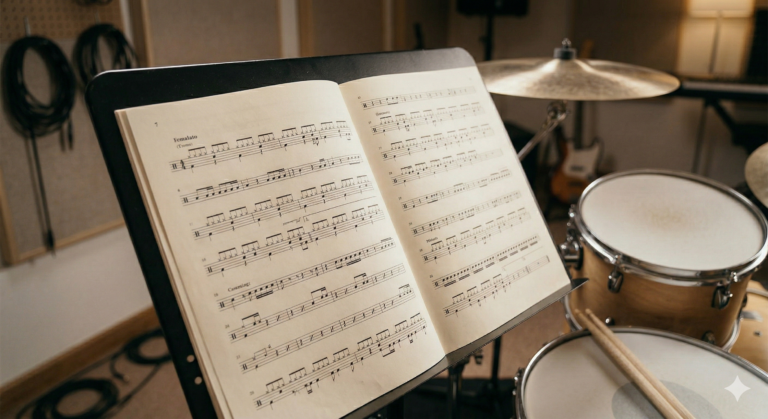
A Step-by-Step Method Using Drum Sheets and Drum Tabs
Learning drum songs is one of the most exciting parts of being a drummer — but also one of the most confusing.
You might watch a video, try to copy the drummer’s hands and feet, maybe search for drum tabs or a drum sheet online, and still feel lost. The groove doesn’t sit right, transitions feel shaky, and the song never sounds solid from start to finish.
Advanced drummers don’t rely on guessing or memory alone. They combine structured practice, drum sheet reading, and focused listening to break songs down efficiently and accurately.
In this article, you’ll learn the exact method experienced drummers use to learn drum songs — with or without a teacher — using drum tabs, drum sheets, and smart practice techniques.
Why Most Drummers Get Stuck When Learning Songs
Most drummers approach new songs like this:
-
Start playing the full song immediately
-
Jump between YouTube videos and random drum tabs
-
Try to memorize fills too early
-
Practice at full tempo
-
Ignore structure and notation
Even when using a drum sheet, many players read it from top to bottom without truly understanding how the song is built.
Advanced drummers work differently.
They use drum tabs and drum sheets as tools, not as crutches.
Step 1: Learn the Song Structure Before Playing
Before sitting at the kit, listen carefully to the song — ideally while looking at a basic drum sheet or writing a rough outline yourself.
You’re not reading detailed notation yet. You’re mapping the song.
Focus on:
-
Intro, verse, chorus, bridge, breaks
-
Repeating sections
-
Length of each section (bars, not seconds)
A simple structure map might look like this:
Intro (4 bars) → Verse (8 bars) → Chorus (8 bars) → Verse → Chorus → Bridge → Chorus → Outro
Many advanced drummers mark these sections directly on their drum sheets or drum tabs, which makes later practice much more efficient.
Step 2: Identify the Main Groove Using Drum Tabs
Most drum songs are built around one main groove.
Before worrying about fills or variations:
-
Look at the drum tab
-
Identify the groove that repeats the most
-
Focus on kick and snare placement first
Even complex drum tabs usually reveal a surprisingly simple core pattern.
Advanced drummers often rewrite messy drum tabs into a cleaner personal drum sheet that highlights only what really matters.
Step 3: Practice Small Sections with Drum Sheets
Instead of reading the entire drum sheet from start to finish, advanced drummers:
-
Practice 1–2 bars at a time
-
Loop short phrases
-
Repeat until it feels automatic
This approach turns drum tabs into actionable practice material, not something you just “read”.
If you’re using a digital drum sheet or tab, looping small sections is especially powerful.
Step 4: Slow Tempo Practice with Drum Tabs
One of the most common mistakes is trying to play drum tabs at full tempo too soon.
Advanced drummers:
-
Start at 50–60% BPM
-
Use the drum sheet as a reference, not a script
-
Increase tempo only when consistency is solid
Slow practice reveals timing issues that fast playing hides — especially when following drum tabs.
Step 5: Add Fills After the Groove Is Stable
Drum tabs often include fills — but that doesn’t mean you should learn them immediately.
Advanced drummers:
-
Learn fills last
-
Practice fills separately from the groove
-
Simplify fills when needed
Many professionals modify drum tabs to better fit their feel, even when following a written drum sheet.
Step 6: Practice Transitions Using Drum Sheets
Most mistakes happen between sections, not inside them.
Instead of practicing entire sections:
-
Practice the last bar of Section A
-
Then the first bar of Section B
Mark these transitions directly on your drum sheet.
This is one of the most overlooked but powerful techniques advanced drummers use.
Step 7: Play Along With the Original Track
Once you’re comfortable reading the drum sheet and executing transitions:
-
Play along with the original track
-
Use the drum tab only as a guide
-
Listen more than you look
At this stage, the drum sheet supports your playing — it doesn’t control it.
Step 8: Record Yourself and Compare to the Drum Tab
Recording yourself reveals:
-
Timing inconsistencies
-
Groove instability
-
Overplayed fills
Compare your playing to the drum sheet or drum tabs, not to perfection.
Advanced drummers constantly refine their interpretation of notation.
Why Drum Sheets and Drum Tabs Work — When Used Correctly
Drum tabs and drum sheets are powerful tools when they are:
-
Structured
-
Clear
-
Combined with focused practice
They don’t replace listening — they support it.
That’s why advanced drummers rely on both ears and notation.
Final Thoughts
Learning drum songs isn’t about talent or speed.
It’s about:
-
Understanding structure
-
Using drum sheets intelligently
-
Practicing in small, focused sections
When you combine drum tabs, drum sheets, and a structured learning method, songs that once felt impossible become achievable.