Drum Sheet Explained: A Beginner-Friendly Guide to Reading Drum Notation
If you’ve ever searched online for a drum sheet to learn a song and felt overwhelmed by the symbols on the page, you’re not alone. Many drummers want to use drum sheets to learn faster, but they assume reading drum notation is complicated or only for advanced musicians.
The truth is much simpler: once you understand the basics of how a drum sheet works, it becomes one of the most powerful tools for learning songs accurately and efficiently. In this guide, we’ll break down drum sheets step by step in a clear, beginner-friendly way — even if you’ve never read music before.
What Is a Drum Sheet?
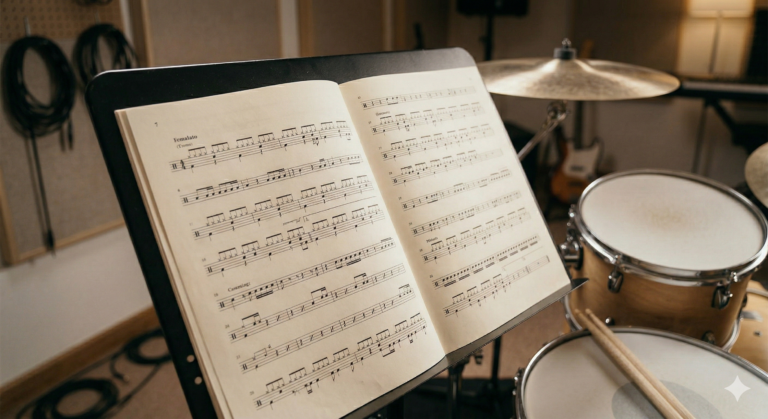
A drum sheet (also called a drum score or drum notation) is a written representation of what a drummer plays in a song. Instead of guessing by watching videos or copying by ear, a drum sheet shows you exactly when and where to hit each drum or cymbal.
Unlike melodic instruments, drum notation focuses on rhythm and coordination rather than pitch. Each symbol on the staff represents a specific part of the drum kit, such as:
- Kick drum
- Snare drum
- Hi-hat
- Toms
- Crash and ride cymbals
A drum sheet is essentially a map of the groove, fills, and structure of a song.
Understanding the Drum Staff
Drum sheets use a version of the standard five-line musical staff. However, instead of notes representing pitch, their vertical position indicates which drum or cymbal you should play.
Here’s a simplified way to think about it:
- Lower positions on the staff usually represent lower sounds (kick drum, floor tom)
- Middle positions often represent the snare drum
- Higher positions represent cymbals and hi-hats
Hi-hat notes are often written as small “x” shapes, while drum hits are shown as solid note heads. This visual difference makes it easier to quickly distinguish between cymbals and drums.
Once you recognize where each instrument sits on the staff, reading a drum sheet becomes much more intuitive.
Rhythm and Note Values
The most important skill in reading a drum sheet is understanding rhythm. Notes are divided into values that tell you how long each hit lasts.
The most common note values you’ll see are:
- Quarter notes – steady beats (1, 2, 3, 4)
- Eighth notes – twice as fast (1 & 2 & 3 & 4 &)
- Sixteenth notes – even faster subdivisions
These rhythms are organized into measures separated by vertical bar lines. At the beginning of a drum sheet, you’ll see a time signature, often 4/4. This tells you how many beats are in each measure.
When you read a drum sheet, you’re essentially counting time while matching each note to a movement on the drum kit.
Reading a Basic Drum Groove
Most drum sheets start with a groove — a repeating rhythm that supports the song. A typical beginner groove might show:
- Hi-hat playing steady eighth notes
- Snare drum on beats 2 and 4
- Kick drum on beats 1 and 3
When written on a drum sheet, these parts are stacked vertically so you can see how they align in time. This vertical alignment is key: it shows which drums are played simultaneously.
Practicing grooves slowly while counting out loud helps connect what you see on the page with what you play physically.
Understanding Drum Fills
Drum fills are short variations that connect different sections of a song. On a drum sheet, fills often look denser, with more notes and movement across the toms.
To read fills effectively:
- Break the fill into small rhythmic chunks
- Identify which drums are being used
- Practice slowly before increasing speed
Instead of trying to play the entire fill at once, focus on accuracy and control. A drum sheet lets you analyze fills visually, making them easier to learn than by ear alone.
Common Symbols and Markings
As you explore more drum sheets, you’ll encounter additional symbols that add expression and detail. Some common markings include:
- Accents (>) indicating stronger hits
- Open hi-hat symbols showing when to release the pedal
- Repeat signs that save space by looping sections
- Dynamic markings that suggest volume changes
These symbols help you play more musically and match the feel of the original performance.
Why Drum Sheets Help You Learn Faster
Many drummers rely only on videos or memory when learning songs. While those methods can work, drum sheets offer several advantages:
- Clarity: You can see the full structure of the song
- Accuracy: Notes are written precisely
- Efficiency: You spend less time guessing
- Consistency: You can revisit sections anytime
Using a drum sheet trains both your rhythmic reading skills and your ability to analyze music. Over time, this leads to faster learning and stronger musicianship.
How to Practice with a Drum Sheet
To get the most out of a drum sheet, use a structured practice approach:
- Listen to the song first to understand the feel
- Read through the drum sheet without playing
- Practice small sections at a slow tempo
- Use a metronome to build timing
- Gradually connect sections into the full song
Patience is essential. Reading drum notation is a skill that improves with repetition and focused practice.
Final Thoughts
A drum sheet may look complex at first glance, but it’s simply a visual guide to rhythm and coordination. Once you understand the layout of the staff, basic note values, and common symbols, you unlock a powerful method for learning drum songs.
Whether you’re a beginner or an experienced drummer, using drum sheets can dramatically improve how you approach practice. They allow you to break songs down, understand structure, and play with greater confidence.
The more you work with drum notation, the more natural it becomes — and the faster you’ll be able to learn and master new music.